


Artist Insight
Barbara Kruger's Politics of Address
Barbara Kruger's most radical move was deceptively simple: she introduced pronouns as weapons. "I," "you," "we," and "they" do not function in her work as neutral placeholders. They assign positions within ideological systems. They implicate viewers rather than inviting detached interpretation.
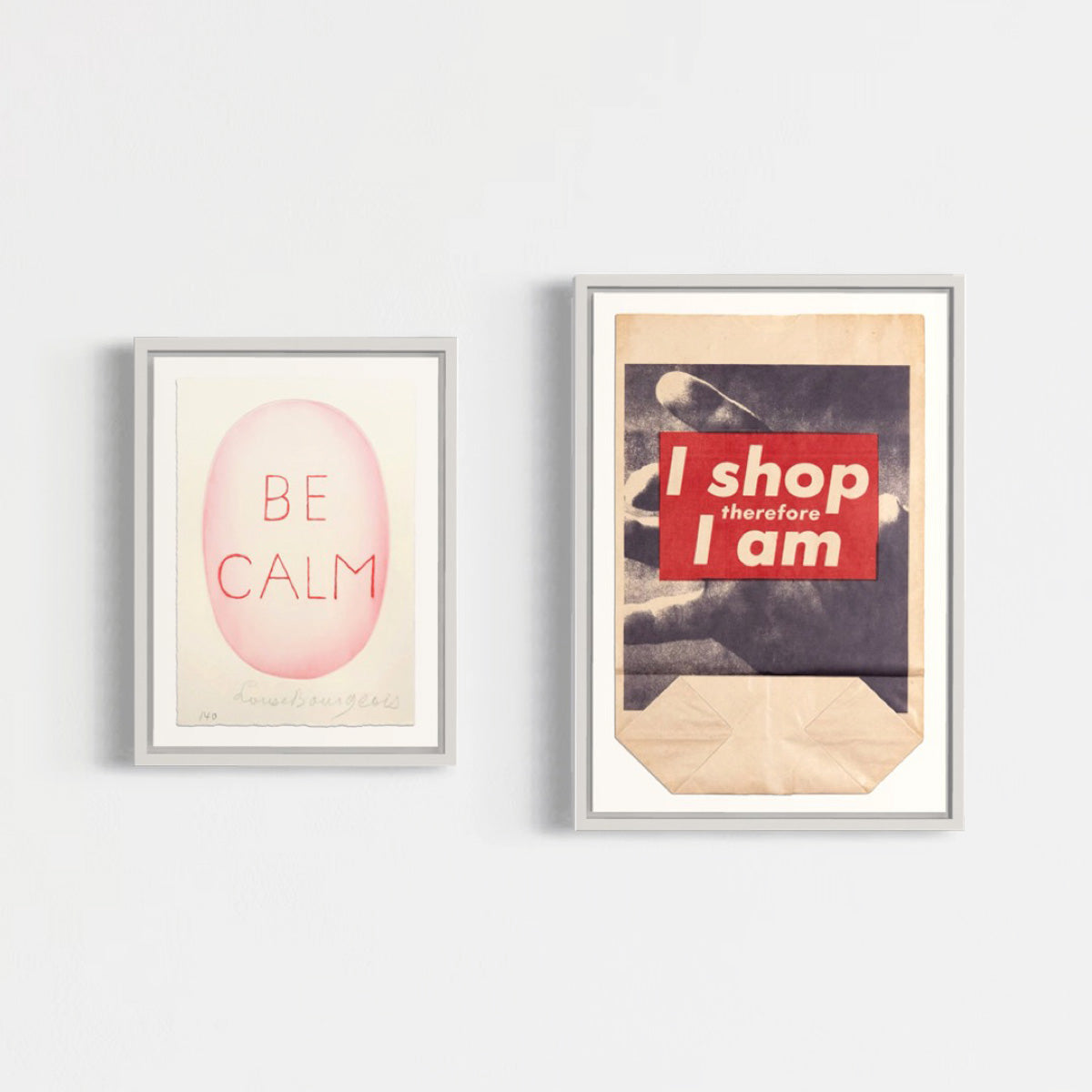
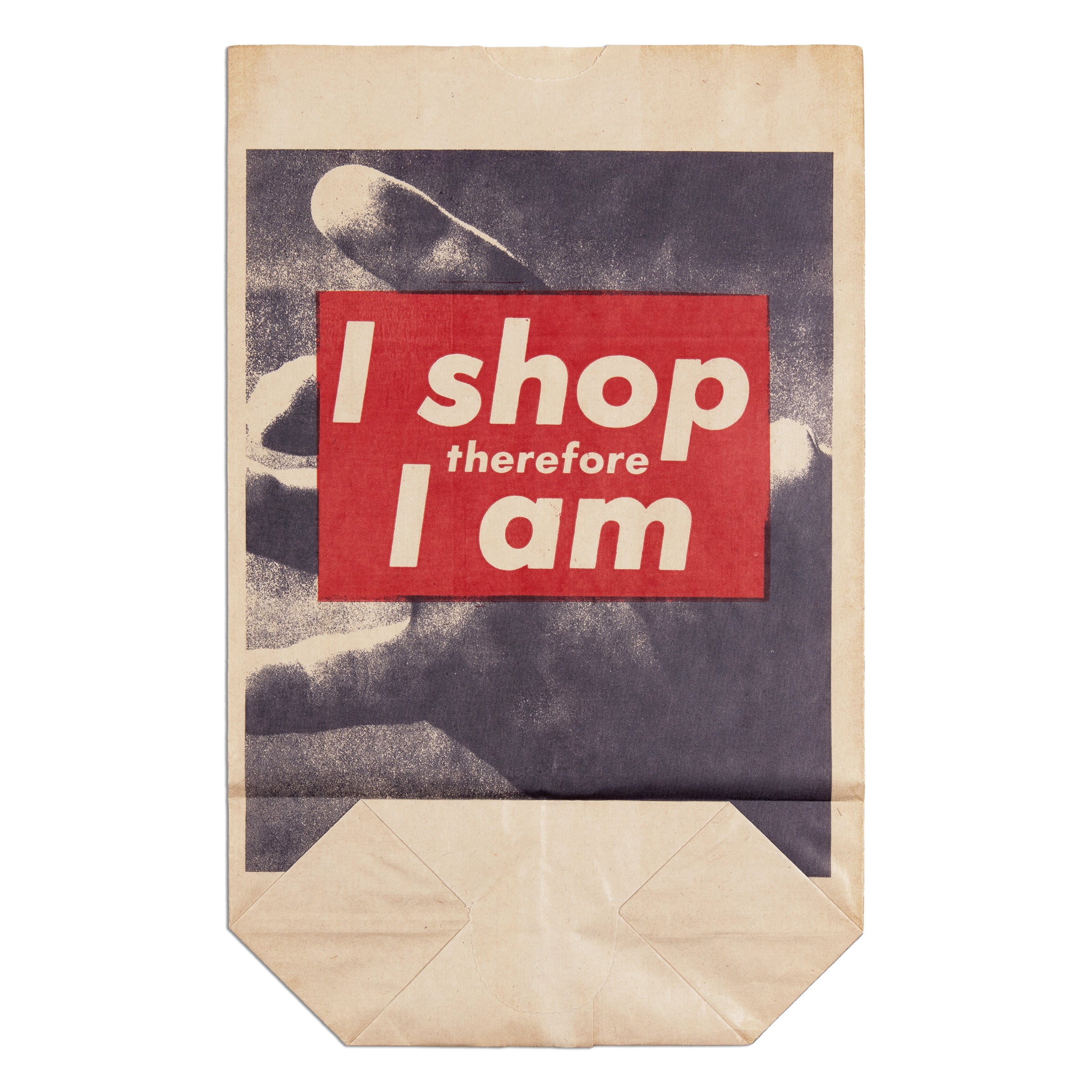
The force of statements such as I shop therefore I am lies not in irony alone, but in structural mimicry. The phrase adopts the confidence of philosophical truth while revealing the extent to which consumer capitalism has colonized identity. The work does not mock belief; it shows how belief is manufactured through repetition, brevity, and typographic authority.
Similarly, Untitled (Your Body Is a Battleground) (1989), produced in support of reproductive rights, condenses media fragmentation and political polarization into a single split image. The body becomes terrain, divided, legislated, surveilled. The poster's durability stems from its lucidity: it names a condition rather than illustrating an opinion.
Kruger's practice insists that address is never innocent. Language does not merely describe social structures; it performs them.
Image as Evidence, Not Illustration
Barbara Kruger's black-and-white photographic sources are rarely original. They are appropriated from advertising, cinema, or mass-circulated imagery — cultural artifacts already saturated with meaning. Her interventions do not beautify or distort these images; they interrupt them. Text overlays fracture the presumed neutrality of representation, exposing the ideological assumptions embedded within gesture, gaze, and bodily posture.
This strategy situates her within a lineage of critical Appropriation and Repetition, yet her tone remains distinct. Where some artists employ ambiguity or distance, Kruger employs confrontation. Her artworks do not drift toward interpretation; they assert their proposition with graphic directness. The clarity is deliberate. Power does not speak hesitantly, and neither does she.
The resulting compositions function less as aesthetic arrangements than as arguments. They demand reading as much as viewing.

Feminism and the Construction of the Body
Barbara Kruger's artwork has long been aligned with feminist discourse, yet it avoids autobiographical narrative. Instead, she addresses the body as a site where ideology, consumption, and discipline converge. Femininity is neither celebrated nor rejected; it is analyzed.
Her use of cropped faces and fragmented figures underscores how bodies are constructed visually before they are experienced physically. The female body, in particular, appears as terrain upon which social and political conflict is staged. Many of the most widely discussed Barbara Kruger artworks engage this constructed visibility, foregrounding how representation becomes regulation. This emphasis on structural analysis rather than personal confession distinguishes her from expressionist modes of feminist art.
By maintaining conceptual distance while deploying emotionally charged imagery, Kruger preserves tension. She does not resolve contradiction; she exposes it.
From Page to Architecture: Barbara Kruger's Art in Space
In later decades,Barbara Kruger expanded from framed photomontages into immersive installations that envelop walls, floors, and architectural surfaces with language. This shift from image-object to spatial environment intensifies her central argument: media is not something we observe from outside. It is the condition we inhabit.
Large-scale artworks wrap institutions in scrolling text, collapsing distinctions between exhibition design and artwork. Visitors move through language rather than toward it. The viewer's body becomes part of the rhetorical field.
This architectural turn also reinforces her engagement with institutional critique. Museums and civic spaces are not neutral backdrops; they are active participants in meaning production. By inscribing language directly onto their surfaces, Kruger exposes the authority they embody.

Barbara Kruger's Prints and Editions
Reproducibility is intrinsic toBarbara Kruger's method. Her use of formats associated with mass communication — posters, billboards, prints, public installations — embraces circulation as both subject and medium. Rather than undermining the critical force of the artwork, reproducibility reinforces it. The image's power lies in its ability to travel.
Barbara Kruger prints and editions occupy a significant place within her practice. From early photomontage prints to later large-scale text works, her limited edition prints extend the logic of circulation while retaining the conceptual rigor of the original installations. These artworks are not secondary to her practice; they are integral to how her art engages reproduction, distribution, and audience.
At the same time, her artwork does not escape commodification. It inhabits the same circuits of exchange it critiques. This tension is not a contradiction but a structural condition. Barbara Kruger's art acknowledges that resistance and participation often coexist within capitalist systems. The work remains lucid about its own embeddedness.
The Legacy of Barbara Kruger's Art
Barbara Kruger’s significance does not reside in a recognizable graphic style, but in a structural intervention that permanently altered how artists approach image and language. By demonstrating that critique can inhabit the very rhetoric it dismantles, she shifted the terrain of politically engaged art from expression to analysis. In doing so, she expanded the possibilities of Conceptual Art beyond philosophical inquiry toward a direct examination of ideology as it operates through visual culture. Her work revealed that power functions not only through institutions and policies, but through syntax, typography, repetition, and address.
The impact of this shift has been profound. Generations of artists working with text, appropriation, graphic strategies, and institutional critique operate within a field she helped articulate. Research-based practices, activist image-making, digital interventions, and discursive installation all inherit her central proposition: that meaning is constructed through systems of representation that must be examined rather than assumed.
Her relevance has intensified rather than diminished. In an era defined by algorithmic targeting, viral messaging, branded identities, and polarized political rhetoric, the mechanisms Kruger exposed have become infrastructural. The pronoun “you” is now personalized, tracked, and monetized. Authority circulates at the speed of a scroll. In this context, her insistence on interrogating who speaks, who is addressed, and how belief is manufactured reads not as historical critique but as ongoing method.
Kruger’s art does not offer spectacle or consolation. It offers a discipline of attention. It teaches viewers to read images as arguments and language as power. Her legacy lies in this literacy — a sustained reminder that the struggle over images is inseparable from the struggle over meaning itself.
SelectedBarbara Kruger artworks are available through our collection.
Seeing is no longer believing. The very notion of truth has been put into crisis.
Selected questions on the artist’s practice, major artworks, and editions.
Barbara Kruger: Key Questions


