



Art Movement Insight

Origins and Early Influences
Although Conceptual Art emerged as a distinct movement in the late 1960s, its intellectual foundations reach back to the early twentieth century, when avant-garde artists first began questioning the assumption that art’s meaning resides in visual form.
The decisive break came with Marcel Duchamp. In 1917 he submitted an ordinary porcelain urinal to an exhibition under the title Fountain, signing it “R. Mutt.” By presenting a mass-produced object as art, Duchamp proposed something radical: the artwork did not need to be crafted or even visually transformed. What mattered was the conceptual act of selection and designation. The object itself was secondary to the idea that framed it.
With Fountain, Duchamp effectively relocated artistic meaning from the object to the intellectual decision behind it. The artwork became a question rather than a display of skill. If a urinal could become art through context and intention alone, then the boundaries separating art from ordinary life suddenly appeared unstable.
Artists associated with Dada and later Surrealism expanded these challenges. Rather than treating art as a purely visual language, they explored how meaning emerges through ideas, symbols, and cultural conventions. The Belgian painter René Magritte, for example, famously demonstrated the instability of representation in works such as The Treachery of Images, where the phrase “This is not a pipe” appears beneath a painted image of a pipe. The work reveals a simple but unsettling truth: images and words do not coincide with the objects they describe.
By the mid-twentieth century, these avant-garde provocations had already undermined the assumption that art must exist primarily as a crafted object. The ground was prepared for a generation of artists who would take Duchamp’s insight to its logical conclusion.

From Object to Proposition
By the late 1960s, many artists began to recognize that Duchamp’s gesture had fundamentally changed the terrain of art. If the meaning of an artwork could reside in the idea behind it, then the physical object was no longer the necessary center of artistic practice.
Conceptual artists therefore shifted attention away from the production of objects and toward the structures that make art legible: language, systems, instructions, and documentation. The artwork could exist as a proposal, a statement, a photograph recording an action, or a set of directions to be carried out by others.
In this new framework, the artist’s role changed as well. Authorship no longer depended on the fabrication of a unique object but on the formulation of an idea. A work might be executed by assistants, repeated in multiple locations, or even remain unrealized while still retaining its identity as art.
Once this logic took hold, the field of artistic practice expanded dramatically. Performances, installations, publications, maps, and archival documentation entered the vocabulary of art-making. Instead of existing as singular objects, artworks could unfold across time, through strategies of appropriation and repetition, or through networks of meaning that extended far beyond the gallery space.
The implications of this shift were profound. Art was no longer defined by medium or material but by the conceptual framework that generated it.

Key Conceptual Artists and Their Ideas
Once the implications of Duchamp’s gesture became clear, a new generation of artists began exploring what art might look like if the idea truly became its central material. During the late 1960s and 1970s, Conceptual Art did not develop through a single style but through a series of experiments carried out by artists working in very different directions.
Among the most influential was Joseph Kosuth, who approached art as a philosophical investigation. His landmark work One and Three Chairs (1965) presents a physical chair, a photograph of that chair, and a dictionary definition of the word “chair.” The work appears deceptively simple, yet it raises a profound question: where does the meaning of an object actually reside — in the thing itself, in its image, or in the language that defines it?
At roughly the same moment, Sol LeWitt transformed Conceptual Art into a system of procedures. His famous statement that “the idea becomes a machine that makes the art” captured the movement’s logic with remarkable clarity. In LeWitt’s wall drawings, the artwork consists of written instructions that can be executed by assistants in different places and at different times. The physical drawing becomes only one realization of a larger conceptual framework.
Other artists explored how images and language shape perception. John Baldessari combined photographs, found imagery, and text to expose the conventions through which images acquire authority. By interrupting photographs with colored dots or pairing images with deadpan captions, he revealed how easily viewers accept visual narratives as truth.
Working in Los Angeles, Ed Ruscha approached conceptual practice through books, serial imagery, and language. His artist’s books — such as Twentysix Gasoline Stations — presented ordinary subjects through systematic photographic sequences, transforming the everyday landscape into a conceptual structure.
In Europe, Joseph Beuys expanded Conceptual Art into the realm of performance and social theory. His work proposed that artistic thinking could extend beyond the studio into political and social life, famously declaring that “everyone is an artist.” Meanwhile On Kawara pursued one of the most rigorous conceptual practices of the twentieth century. His Date Paintings and telegram works recorded the simple fact of existence — the passage of a single day — turning time itself into the material of art.
Taken together, these artists did not establish a unified visual language. Instead, they demonstrated that the artwork could function as a proposition, a system, a linguistic structure, or a temporal record. Conceptual Art became less a style than a method: a way of asking what art is, how it operates, and why it matters.

Photography, Language, and Systems
As Conceptual Art expanded during the late twentieth century, artists increasingly turned to photography and language as primary artistic tools. Photography offered something that painting and sculpture could not: a way to record actions, locations, and ideas without claiming aesthetic finality. A photograph could function as evidence — a trace of a gesture, an event, or a conceptual proposition.
Language played a similarly structural role. Words could define the parameters of an artwork, guide the viewer’s interpretation, or expose the assumptions embedded within representation itself. For many conceptual artists, language was no longer a description of the artwork but its central material, giving rise to practices often described as text-based art.
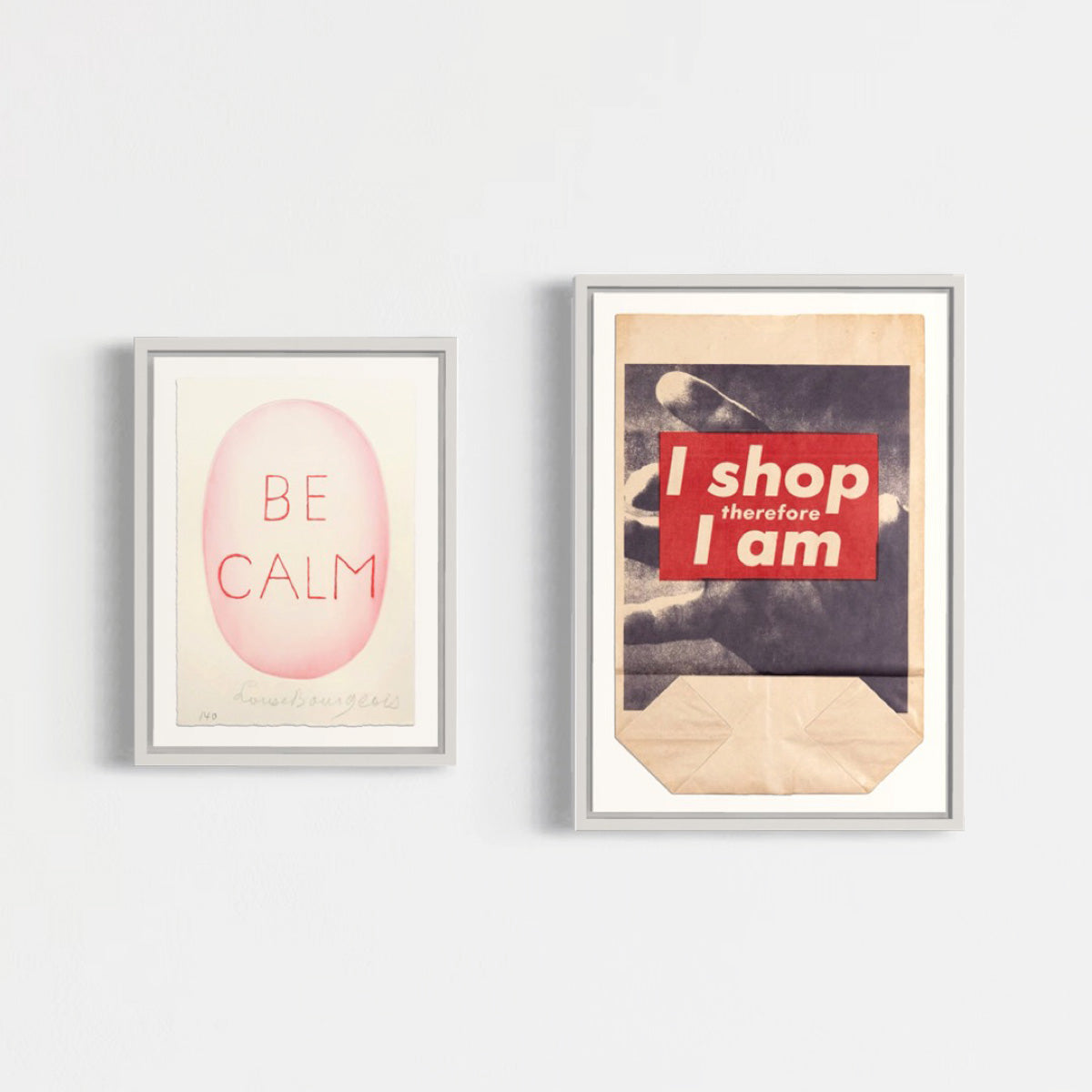
Artists such as John Baldessari, Joseph Kosuth, and Sol LeWitt explored how text, instructions, and systems could operate as complete artworks. Later figures including Barbara Kruger and Jenny Holzer expanded these strategies by bringing language directly into public space. Through slogans, LED installations, posters, and projections, they transformed text into a powerful visual medium capable of confronting politics, identity, and mass media.
Photography developed along a similarly conceptual trajectory. The German artists Bernd and Hilla Becher, for example, created systematic photographic typologies of industrial structures, presenting water towers, blast furnaces, and gas tanks as rigorous visual archives. Their work treated photography not as expressive image-making but as a method of classification and analysis, laying important foundations for what would later be described as conceptual photography.
Later generations extended these ideas in different ways. Thomas Ruff examined how photographic images circulate within technological systems, producing works that range from pixelated internet images to large-scale portraits that question the authority of photographic representation. Thomas Demand, meanwhile, constructs elaborate paper models of architectural spaces before photographing them, transforming photography into a meditation on memory, mediation, and the fragile boundary between reality and representation.
Through these developments, photography and language became central instruments of conceptual thinking. Images, words, and systems were no longer secondary elements of art but the very structures through which artistic ideas could unfold.

Legacy and Influence
In many respects, contemporary art as we know it would be impossible without the intellectual foundations established by the pioneers of Conceptual Art. Artists such as Marcel Duchamp, Joseph Kosuth, and Sol LeWitt shifted the definition of art away from the physical object and toward the idea, the system, or the process that generates it. This transformation laid the groundwork for what is often described as the “post-medium” condition of contemporary art, in which no single material or technique defines artistic practice.
One of the most lasting consequences of Conceptual Art is the dematerialization of the artwork. Once the idea became central, artists were free to work with any medium — performance, data, social interaction, installation, or digital systems — without being bound to traditional forms such as painting or sculpture. At the same time, conceptual strategies opened the door to Institutional Critique, encouraging artists to question how museums, galleries, and markets shape the meaning and value of art.
Conceptual Art also transformed the role of the viewer. Rather than passively encountering a finished object, the audience often completes the work by interpreting instructions, reconstructing ideas, or engaging with the conceptual framework that underlies the artwork. This shift would later contribute to the emergence of participatory and relational practices across contemporary art.
The legacy of Conceptual Art is clearly visible in later generations of artists. Maurizio Cattelan, for example, employs conceptual gestures and institutional satire to question the structures of authority surrounding art. Ai Weiwei integrates conceptual strategies with political critique, using objects, documentation, and architectural interventions to examine questions of power and cultural memory. Even artists working at the intersection of spectacle and conceptual systems, such as Damien Hirst, continue to explore the relationship between idea, authorship, and value within contemporary art.
Conceptual thinking also persists within painting. Artists such as Peter Halley translate conceptual frameworks into diagrammatic abstraction, mapping social and technological systems through geometric forms. Painters like Luc Tuymans approach the medium through a similarly conceptual lens, treating images as mediated fragments of history and memory rather than autonomous aesthetic objects.
Conceptual Art therefore functions not as a closed historical movement but as an enduring methodological foundation for contemporary art.

The Logic of the Multiple: Circulation as Art
Conceptual Art has always maintained a vital relationship with printed matter and editioned works. In a movement where the artwork exists as a proposition, instruction, or system, the reproducible format is not a compromise—it is the ideal medium. It allows the idea to escape the confines of a singular object and enter a broader cultural system of circulation.
Early pioneers, such as Ed Ruscha, demonstrated that the book itself could function as a complete conceptual artwork. By utilizing sequence, repetition, and mass distribution, these publications transformed the modest format into a rigorous artistic structure. Here, the vehicle of delivery is as much a part of the work as the content itself.
Diagrams, instructions, and prints serve as essential vessels through which conceptual ideas travel. Rather than acting as secondary documentation, these formats often constitute the primary artwork, enabling the idea to exist independently of a unique physical relic.
For the collector, editions offer a direct and authentic encounter with the conceptual tradition. They are not mere reproductions, but integral expressions of an artistic logic that values dissemination and accessibility. In this sense, Conceptual Art permanently redefined the relationship between medium and audience—shifting value from the object to the idea, a transformation that continues to shape contemporary art and the way we collect it today.
Explore conceptual art prints and editions available in our collection.
The idea becomes a machine that makes the art.
Selected questions on this topic, its key figures, and its editions.
Conceptual Art: The Idea as Artwork: Key Questions


