

Art Movement Insight
From Monuments to Contemporary Public Art
For most of its history, art in public space was commemorative. The equestrian statue, the war memorial, the allegorical figure above a bank entrance: these were arguments about who a society honoured, cast in durable material and placed where they could not be avoided. The monument did not ask the viewer to interpret. It asked the viewer to agree.
Two twentieth-century shifts broke that model. The first was abstraction, which arrived in the civic square without the shared symbolic vocabulary monuments depend on. The second was bureaucratic, and its consequences were larger. In 1959 Philadelphia became the first American city to adopt percent-for-art legislation, requiring that one percent of qualifying construction budgets be spent on art. The model spread widely; in 1967 the National Endowment for the Arts established its Art in Public Places programme, whose first commission was Alexander Calder's stabile La Grande Vitesse, dedicated in Grand Rapids, Michigan, in 1969.
The effect was to create a reliable funding stream for art in public space that was not tied to commemoration. Artists could now be paid to put something in a plaza without being asked to honour anyone. What they should put there instead became an open question, and it has stayed open.

Land Art and the Expansion of the Artwork
In October 1968 the Dwan Gallery in New York mounted Earth Works, an exhibition of art made from and about the ground. Virginia Dwan later explained the premise plainly: the artists could not find available land, so the show came indoors. What hung on the walls were largely photographs and documents of things that existed, or were proposed, somewhere else. Four months later Cornell's Andrew Dickson White Museum staged Earth Art, with Richard Long and Günther Uecker among the participants. That April, the German curator Gerry Schum broadcast Land Art on ARD television: an exhibition with no venue, transmitted into living rooms.
The sequence matters. Within six months, a tendency defined by its removal from the gallery had been introduced to its audience through a gallery, a university museum and a television set. Land Art was mediated from the beginning. This is not a later compromise but a structural condition of the form, and it explains why photographs, films and printed editions occupy such a central place in the field.
The terminology has never settled. Earthworks and Earth art were the American usages; Land Art was European and has become the general term. Environmental art is broader again, and today often carries an ecological charge the 1960s artworks did not claim.
The defining example is Robert Smithson's Spiral Jetty, built in April 1970 at Rozel Point on the Great Salt Lake in Utah. Using dump trucks and a front loader, Smithson displaced some six thousand tons of black basalt and earth into a coil 1,500 feet long and about 15 feet wide, winding counterclockwise into the water. He chose the site for geological reasons before aesthetic ones: the water runs reddish from microbial activity, and the spiral echoes the molecular lattice of the salt crystals encrusting the shore.
The governing idea was entropy — an artwork with no fixed state, decaying from the moment of completion. He got one. Spiral Jetty vanished beneath rising water in 1972 and stayed submerged for three decades; drought exposed it again in 2002, and the lake has since retreated nearly a mile from it. It was donated to Dia Art Foundation in 1999 by Nancy Holt and the Estate of Robert Smithson, and Dia has documented it from the air since 2012. An artwork designed to be unstable has become, incidentally, a record of a drying inland sea.
Smithson built the conceptual machinery in print as much as in earth. His Artforum essays — “Entropy and the New Monuments” (1966), “A Tour of the Monuments of Passaic, New Jersey” (1967) — are part of the artwork rather than commentary on it, and his Site/Nonsite pieces, which brought rocks and maps from a specific location into the gallery, posed the problem with unusual clarity: how does a place get into a room? The Spiral Jetty film of 1970 answers it as well as anything. Most people who know the artwork know it through images. Smithson died in a plane crash in Texas in 1973, aged 35.
Other landmarks of the period followed the same logic at different scales.
Michael Heizer cut Double Negative (1969–70) into a mesa in Nevada — two trenches facing each other across a gap, 240,000 tons of rock displaced, financed by Virginia Dwan and given to the Museum of Contemporary Art, Los Angeles, in 1985.
Walter De Maria set four hundred polished steel poles in a grid across high desert in western New Mexico for The Lightning Field (1977), stewarded since by Dia Art Foundation and experienced only by overnight stay.
Nancy Holt aligned the four concrete cylinders of Sun Tunnels (1973–76), in Utah's Great Basin Desert, to the solstice sunrises, piercing them with constellation holes so that the landscape became an instrument for looking at the sky.
In 1979 the critic Rosalind Krauss gave the shift its most durable formulation in October, arguing in “Sculpture in the Expanded Field” that sculpture had become a category defined by what it was not — not architecture, not landscape — and that the artists working in this negative space had opened a genuinely new set of possibilities.

Richard Long and Art Through Walking
The American earthworks required heavy plant, capital and land rights. The British alternative required a pair of boots.
Richard Long walked back and forth across an English field in 1967, while still a student at Saint Martin's School of Art, until the flattened grass caught the light as a straight pale line. He photographed it and left. A Line Made by Walking is held by Tate as a gelatin silver print with graphite on board. The line itself recovered within days.
It is hard to overstate how much that modest gesture rearranged. Long made sculpture without carving, casting, buying land or applying for permission, and without leaving anything behind that needed maintaining. The medium was duration and movement; the residue was an image and a caption. He went on to walk Dartmoor, the Andes, the Sahara and the Himalayas, recording each in photographs, maps and spare text pieces that state a distance, a number of days, a place, and nothing more. He was awarded the Turner Prize in 1989.
The point matters for anyone thinking about how such practices are collected. A Long photograph or text edition is not documentation of a sculpture held elsewhere. There is no elsewhere. The sheet is where the artwork lives.
Long's position also corrects a common assumption. Land Art is often taken to mean vast permanent alteration of remote terrain. A great deal of it was the opposite — temporary, small, unproprietorial, concerned with walking and weather — and both tendencies sit in the same 1969 exhibitions.

Christo and Jeanne-Claude: Art as Temporary Public Experience
Christo and Jeanne-Claude took the problem of public consent more literally than anyone. Their projects were temporary by design, free to everyone, and financed entirely by the artists themselves, who accepted no sponsorship, no public money and no commissions. Every permission had to be won by argument rather than purchase.
The method was visible early, and indoors. The Store Fronts of the mid-1960s rebuilt ordinary commercial facades at full scale inside the gallery and then sealed them: windows papered or curtained, nothing to see through. Corridor Store Front (1966–68) was the most ambitious of them, planned across roughly 1,560 square feet — about 95 by 19 feet, 12 feet high — and developed through drawings, a lit architectural model now at the National Gallery of Art in Washington, and a two-part screenprint issued in 1968. A street brought into the gallery and shut, it inverts the gesture the artists spent the next four decades making outdoors.
Running Fence (1972–76) is the clearest demonstration of the outdoor method. An 18-foot-high white nylon fence, 24.5 miles long, ran west across the hills of Sonoma and Marin Counties and dropped into the Pacific at Bodega Bay. Getting it there took forty-two months, leases from fifty-nine ranchers, eighteen public hearings, three sessions in the Superior Courts of California and a 450-page environmental impact report — the first ever prepared for an artwork. It stood for fourteen days from 8 September 1976, and nothing remains on the hills.
The process was not an obstacle to the artwork but a substantial part of it. Those hearings put hundreds of people who had never discussed contemporary art into a room to argue about what a fence across their land might mean. Jeanne-Claude's recorded reply to one sceptical rancher — that a work of art needs no purpose — is as concise a statement of the artists' position as exists.
Wrapped Reichstag turned the same method on a building saturated with history. Christo conceived it in 1971 and it took twenty-four years; he visited Germany some fifty times and lobbied deputies directly, and on 25 February 1994 the Bundestag held a full plenary debate on a single artwork, voting 292 to 223 in favour. On 24 June 1995, climbers unfurled 100,000 square metres of aluminised fabric, secured with blue rope, over the parliament of a country reunified for less than five years. It stood fourteen days and drew more than five million visitors. The Gates (1979–2005) took twenty-six years to authorise: 7,503 saffron fabric panels along twenty-three miles of Central Park walkways, in place for sixteen days, then dismantled and recycled.
All of it was paid for by selling art. Every project was funded through the sale of Christo's preparatory drawings, collages, scale models and original lithographs. The editions were not souvenirs issued afterwards but the working capital raised beforehand — and they are now the only form in which these projects can be owned at all. The fabric is gone; the sheets are what is left.
Jeanne-Claude died in 2009, Christo in 2020. L'Arc de Triomphe, Wrapped was realised posthumously in Paris in September 2021, sixty years after it was first imagined.

Tilted Arc: When Public Art Loses Its Public
If Running Fence shows public consent being won, Tilted Arc shows what happens when the question is never properly asked.
Richard Serra was commissioned through the General Services Administration's Art in Architecture programme, and his sculpture was installed at 26 Federal Plaza in Manhattan on 16 July 1981: a curving wall of weathering steel, 120 feet long and 12 feet high, cutting the plaza in two. Serra intended that crossing the square should make people conscious of their own movement through it. By September, roughly 1,300 federal employees who worked there had signed a petition for its removal.
A three-day public hearing was held in March 1985, and the transcript does not say what it is usually reported to have said. Of those who testified, 122 spoke in favour of keeping the sculpture and 58 for removing it. The five-person panel, chaired by the GSA administrator who had convened the hearing, voted 4–1 to remove it anyway.
Serra's argument was precise and, on its own terms, unanswerable: the artwork had been commissioned for that plaza, its meaning was inseparable from it, and to remove it was therefore to destroy it. The courts rejected his claims, and on the night of 15 March 1989 federal workers cut Tilted Arc into three sections and carted them to storage. It has never been shown since.
The case is usually told as a parable about an arrogant art world and an alienated public. It is more interesting than that. The sculpture was imposed on a workforce that used the plaza daily and was never consulted; the hearing produced a majority in its favour and a decision against it; and the legal finding established that in the United States, ownership of the object generally outranks the artist's claim over its meaning. All three are true at once, which is why the episode is still argued about.

Street Art, Urban Art and the City
While artists were negotiating with planning commissions, a parallel tradition was declining to ask.
Graffiti writing spread through New York and Philadelphia from the late 1960s as a practice of name and territory, carried on subway cars through every neighbourhood in the city — a distribution network no gallery could match. What followed in the late 1970s and 1980s was different: artists applying the methods of the street to image-making rather than lettering. Keith Haring drew in chalk on the black paper covering expired subway advertising panels, producing thousands of drawings between roughly 1980 and 1985. Jean-Michel Basquiat, with Al Diaz, wrote under the tag SAMO© in Lower Manhattan from 1977. In Paris from 1981, Blek le Rat stencilled life-size rats and figures on walls, establishing a vocabulary later artists worked directly out of.
Three features separate this from everything above. It is made without permission, and so is legally vandalism regardless of quality. It is made quickly, because the maker can be arrested. And it is made in the knowledge that it will be destroyed — painted over, tagged, weathered off, or cut out of the wall and sold.
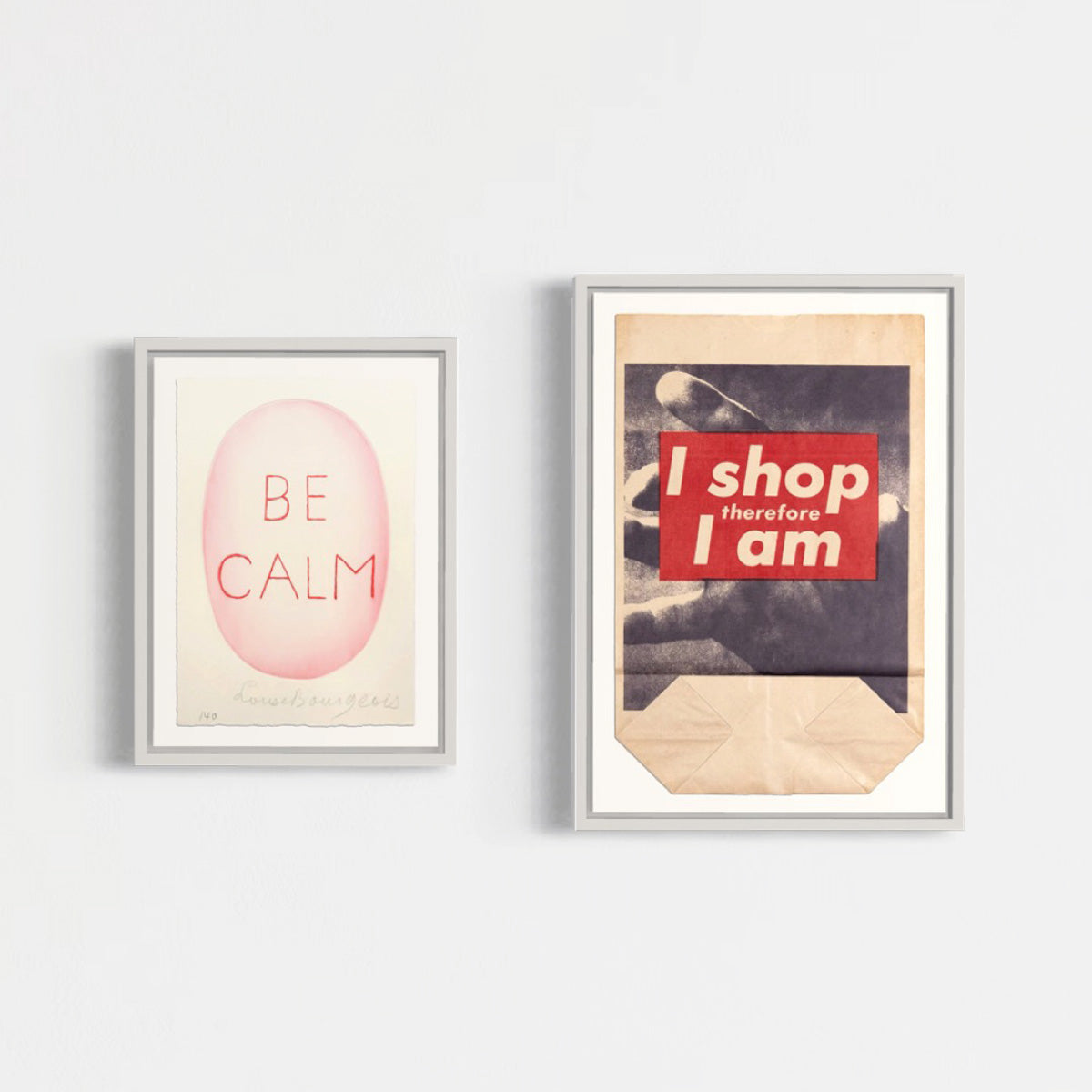
Artists working inside the institution arrived at the street from the opposite direction. Jenny Holzer fly-posted her Truisms anonymously around Manhattan from 1977 and put them on the Spectacolor board in Times Square in 1982. Neither she nor Barbara Kruger is a street artist in the unsanctioned sense. Both understood that the street is where language does its work.
Urban Art is the term that emerged once street practice acquired a market — useful, because a real category exists: work rooted in the visual language of the street but made for commissioned walls, or for paper, canvas and editions. Uncomfortable, because the shift from unsanctioned to sanctioned alters the thing fundamentally. A stencil sprayed at night is a trespass with a message. The same image on a developer's hoarding is a decorative asset.
The passage from one to the other is well documented.
Invader has been fixing ceramic tile mosaics of 8-bit video-game characters to buildings since the late 1990s, mapping cities by “invasion” and keeping his own catalogue of them — an unsanctioned practice with the bookkeeping of a museum registrar.
KAWS began by painting over bus-shelter advertisements in New Jersey and New York in the 1990s, and now makes editions, sculptures and monumental inflatables for institutional and commercial commissions worldwide.
Banksy made his sharpest comment on that economy from inside it. At Sotheby's in October 2018, Girl with Balloon sold for £1 million and a shredder concealed in the frame destroyed the lower half of the canvas as the hammer fell. Retitled Love is in the Bin, it returned to Sotheby's in October 2021 and sold for around £18.5 million — then a record for the artist. An attack on the auction room produced the most valuable object of his career.
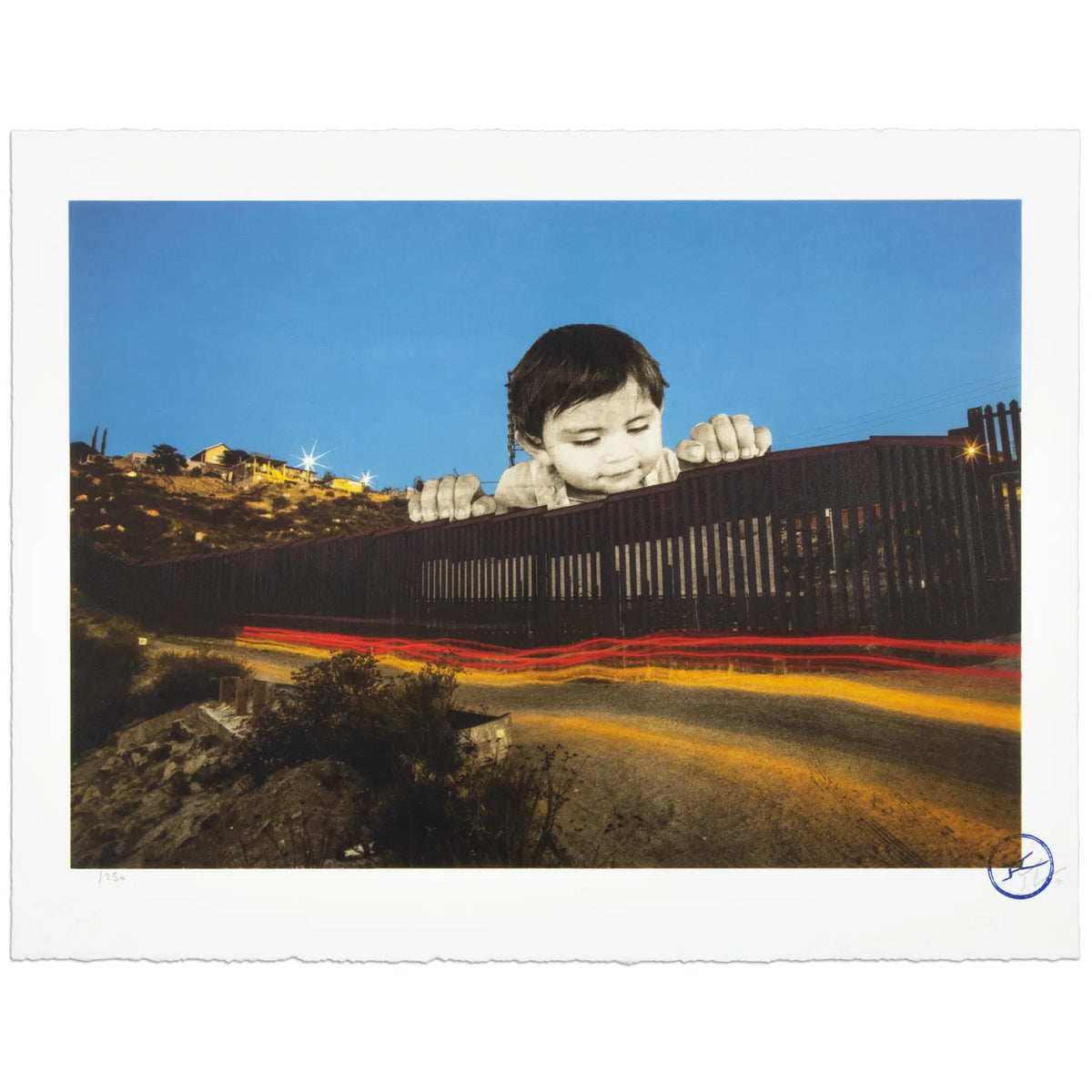
JR works at the other end of the same problem. Born in Paris in 1983, he began pasting large black-and-white portraits on walls in Clichy-Montfermeil in 2004. In 2007 Face 2 Face put enormous paired portraits of Israelis and Palestinians — pulling the same faces — on walls either side of the Separation Barrier in eight cities. The method depends on consent at every stage; the heroes of the project, he has said, were the people on both sides who let him paste portraits on their houses. In 2011 he received the TED Prize and used it to launch Inside Out, which sends people a printed portrait of themselves to post in their own public space.
The critical question is not whether such artists sold out, but what the street contributed that the gallery could not, and whether the work still carries it. The answers vary. Invader's practice loses little in editioned form, because the mosaic was always a modular unit. A Banksy mural depends heavily on the wall it was put on, which is why the cut-out-and-sold murals so often look inert in a saleroom.

Commissions, Biennials and Public Memory
The institutions that now shape public art were largely built in response to public hostility, which is a fact worth sitting with.
Skulptur Projekte Münster began exactly that way. Residents reacted with fury to a kinetic sculpture by George Rickey installed in the early 1970s, and the curator Klaus Bußmann concluded that the answer was not fewer sculptures but better public argument about them. With Kasper König he staged a two-part exhibition in 1977: a survey inside the museum, and nine artists — among them Joseph Beuys, Donald Judd and Claes Oldenburg — making work in the city. The decisive choice was the interval. Skulptur Projekte recurs once every ten years, which makes it something no annual event can be: a longitudinal record of how sculpture in public space has changed, measured against the same streets and largely the same residents.
Joseph Beuys made his most consequential public artwork at documenta 7 in Kassel in 1982. 7000 Oaks paired each of seven thousand trees with a basalt column, planted across the city over years rather than installed in an afternoon. He did not live to see it finished; the last tree was planted in 1987, the year after his death. It remains the clearest demonstration that a public artwork can be a process lasting longer than the artist.
Museums became commissioners too. Tate Modern's Turbine Hall put installation art in front of audiences numbered in millions — Olafur Eliasson's The Weather Project (2003) filled the hall with an artificial sun and a mirrored ceiling, and people lay on the concrete floor for hours looking at themselves. New York's Public Art Fund, founded in 1977, became the model for the commissioning body that is neither museum nor municipality; its 1982 commission of Agnes Denes's Wheatfield — A Confrontation, two acres of wheat planted on landfill within sight of Wall Street, remains one of the most economical political statements made in a city.
Ai Weiwei inverted that gesture in Porto. Pequi Tree (2021) is a 32-metre iron cast of an endangered pequi vinagreiro from Brazil's Atlantic forest — moulded on site in Brazil, cast in China, shipped to Portugal and assembled in the grounds of the Serralves Foundation, where it stood through the exhibition Ai Weiwei: Intertwine (July 2021 to July 2022), curated by Philippe Vergne and Paula Fernandes. Where Beuys planted seven thousand living trees, Ai Weiwei raised a single dead one in rust-coloured iron and described it as a warning about what stands to be lost. Serralves later published the sculpture as a pewter edition at 32 centimetres, in 250 numbered copies — the monument reduced to the scale of a mantelpiece, and the only form of it anyone can own.
Katharina Grosse works at comparable scale in sprayed colour. In 2016 she saturated a derelict building on the Rockaway peninsula in New York — architecture treated as canvas, and demolished afterwards as planned. In 2025 she brought the same method to the forecourt of Art Basel, spraying some 53,000 square feet of the Messeplatz in white and magenta for CHOIR, curated by Natalia Grabowska. It took six days to make and stood for seven, directly outside the most concentrated week of trading in the art calendar. Grosse's own description of it was flat: “You can't buy it, you can't own it.”
Monuments, meanwhile, have returned to the centre of public argument. Maya Lin won the Vietnam Veterans Memorial competition in 1981 as an undergraduate; her wall of polished black granite, inscribed with names in order of death and cut into the ground rather than raised above it, was attacked as defeatist and is now among the most visited memorials in the United States. The removals of recent years have made explicit what public sculpture always was: a claim about who a community honours, enforced by permanence. A monument is an argument that has been allowed to set. Taking one down is not the destruction of history but the resumption of a debate that was closed by casting it in bronze — and reasonable people disagree about particular cases.
The conditions that produced all of this have intensified. Spiral Jetty now sits nearly a mile from a lake retreating for reasons Smithson did not anticipate, and entropy reads differently in a drying basin than it did in 1970. The city has gone the other way: public space is denser with commissioned imagery than at any point in history, nearly all of it advertising. In that environment an unauthorised image is no longer transgressive simply by existing. The artists who still manage it offer what advertising structurally cannot — ambiguity, duration, or an invitation to participate rather than to buy.

Public Art and the Collector
Almost everything described above is gone, or was never ownable in the first place. The fence came down after fourteen days. The Reichstag was unwrapped. The gates were recycled. The line in the grass grew back. Tilted Arc was cut into three pieces. The mural was painted over on Thursday morning.
This is not a problem the market solved afterwards. It is a condition the artists worked inside from the beginning. For Christo and Jeanne-Claude the editions were the finance: drawings, collages, models and lithographs sold to pay for projects that refused sponsorship, which makes the printed sheet a precondition of the artwork rather than a by-product. For Richard Long, the photograph and the text piece are the form in which a walk becomes public at all. For artists who began on the street, the edition is often the only version anyone can legitimately own, because the wall belongs to somebody else.
Three consequences follow for collectors. First, documentation and artwork are not always distinguishable, and the difference matters: an image issued, signed and editioned by the artist stands differently from a press photograph of the same project, and practices vary in how they treat that line. Our glossary of editions sets out the vocabulary. Second, provenance carries unusual weight — in a field defined by removed, demolished and unauthorised artworks, the chain of custody and the authentication route are the thing being bought. Third, scale is not status. A monumental project and a signed lithograph from the same practice are not a hierarchy; the sheet frequently came first, paid for the project, and outlived it.
MLTPL deals in signed prints, photographs and multiples by museum-collected artists, including several of the figures discussed here. Our notes on collecting prints and editions cover the market in more general terms.
A work of art needs no purpose, it is beautiful.
Selected questions on this topic, its key figures, and its editions.
Public Art: From Land Art to Urban Art: Key Questions


