











Collector Insights · Art & Investment
|
$526M Global auction turnover, PRINTS 6 MULTIPLES, 2025 |
198,100 lots sold worldwide, 23% of all fine-art auction transactions |
30 loTS CROSSED $1 MILLION, LED BY WARHOL MARILYN SET AT $5.2M |
Why Editions Offer What Unique Artworks Cannot
A unique painting by a prominent artist can easily cost €100,000 or multiples of that. For most collectors the choice is not between a Richter painting and a Richter print — it is between a Richter print and not owning Richter at all. Editions solve this without compromising on the artist. But they also do something structurally that originals cannot: they generate comparable transaction data over time. Because multiple impressions exist and trade repeatedly, a collector can observe how the same image has performed across the secondary market — how proof variants compare to standard impressions, how prices have held through economic cycles. That evidence is simply unavailable for unique works.
There is also a plain supply-and-demand argument. Once an edition sells through, no further impressions can be created. As an artist's cultural relevance compounds — through retrospectives, institutional acquisitions, and critical reappraisal — a fixed edition supply means pricing pressure is structurally one-directional over the long run.
The market has already demonstrated what this maturation looks like at its upper end. In 2022, Ed Ruscha's Standard Station (1966) — a single screenprint — sold at Christie's New York for $554,000 including premium. In the same year, Andy Warhol's Marilyn Monroe (1967) achieved $3.4 million including premium. These are not unique paintings. They are editioned prints, and they are trading at prices that command serious institutional attention.
|
$554,000 Ed Ruscha — Standard Station (1966) |
$3.4M Andy Warhol — Marilyn Monroe (1967) |
Liquidity and Resale: Why Editions Are Easier to Sell
Liquidity does not mean a work is famous, nor that it once achieved a high price. It means the work can be sold again at a fair level, within a market that has enough comparable evidence and buyer depth to support that transaction with confidence. By that definition, many unique works — even by prominent artists — are relatively illiquid.
Editions are structurally more liquid. Because they have traded repeatedly, there is an established reference price. Because multiple impressions exist, the potential buyer pool is broader. Authentication is also far more straightforward — provenance, certificate, and catalogue raisonné reference are typically sufficient. There is a further benefit that is rarely discussed: editions are far less susceptible to "burning" their own market. With unique works, one failed auction can permanently damage perception of a work. With editions, multiple impressions trade at intervals and no single result defines the trajectory.

What Makes a Limited Edition Print Investable?
Not all limited edition prints are investment-grade assets. A signature does not make something investable, and neither does a small edition size alone. Value in the secondary print market is shaped by a specific combination of factors — and understanding them is the difference between buying well and buying hopefully.
| 01 | Market depth, not just name recognition. An artist's fame creates awareness, but depth is what creates a functioning secondary market. Depth means enough active buyers — across geographies and auction houses — competing for the same works over an extended period. An artist whose market is wide but thin may still produce prints that are genuinely hard to exit at a fair price. |
| 02 | A pattern of consistent resale, not a single headline result. One standout auction price is a data point, not a market. What matters is whether comparable impressions trade within a predictable and ideally rising range across multiple events over years. Consistency is the only honest basis for projecting forward value. |
| 03 | The impression itself, not just the edition title. Within the same numbered edition, condition differences can create real and sometimes substantial price divergence. Paper ageing, margin integrity, storage history, and framing choices all account for meaningful differentials between nominally identical impressions. An artist's proof (A/P) often commands a premium — but only in exceptional condition. |
| 04 | Image significance within the artist's catalogue. Certain works achieve cultural resonance far beyond the rest of an artist's output and trade at persistent premiums. You are not investing in an artist in the abstract — you are investing in a particular image at a particular moment in that artist's cultural reception. That distinction is everything. |
| 05 | A clear exit strategy before you commit. Public auction provides visibility, but commission structures and timing are not always in your control. Private sales are increasingly relevant in the mid-market and often produce better net outcomes. Knowing your route before purchase is the clearest sign of a collector thinking structurally rather than speculatively. |
There is a sixth consideration that deserves to be stated plainly: diversification within the art allocation itself. No wealth manager would advise a client to concentrate an entire equity position in a single stock — however well-chosen. The same logic applies to collecting. Acquiring several prints by different established artists is structurally more resilient than concentrating the same budget in a single unique work, however prestigious. It distributes artist-specific risk, broadens access to liquidity, and creates a collection with genuine range that can weather periods where one market cools.

The Tax Advantages of Collecting Art
For collectors in Germany and much of Continental Europe, the financial case for art is strengthened by a structural tax advantage that is frequently overlooked. Private individuals who hold an artwork for at least one full year may sell it entirely free of capital gains tax — an appreciation that would attract tax in equities or property is realised without friction in art. For anyone in a high marginal bracket, that differential is significant.
Switzerland goes further: for private collectors, capital gains on art are tax-exempt with no minimum holding period required, provided the activity remains private management rather than professional trading. In the UK, individual works sold for £6,000 or less are fully exempt from CGT — relevant for a meaningful share of the edition market — and the broader framework rewards careful planning. In the US, the step-up in basis at death and charitable donation routes offer collectors real planning opportunities despite a structurally less favourable headline rate. Tax frameworks vary by jurisdiction and evolve over time; in most markets, however, the detail rewards serious attention.
For companies, law firms, and medical practices the case is doubly compelling: art acquired for business premises can often be deducted as a business expense, while simultaneously upgrading the environment and projecting cultural credibility to clients and staff. Specific decisions should always involve qualified advice.
Which Artists' Prints Are Worth Collecting?
Artist selection is the single most important variable. Everything else — condition, provenance, timing — operates within the constraints that choice establishes.
Emerging artists offer the highest potential upside and the highest probability of a total loss. Fewer than one in ten who attract initial attention sustain meaningful market presence over time. Established artists offer the most legible risk profile: their price development is transparent, trackable through auction records, and largely resistant to career-related shocks.
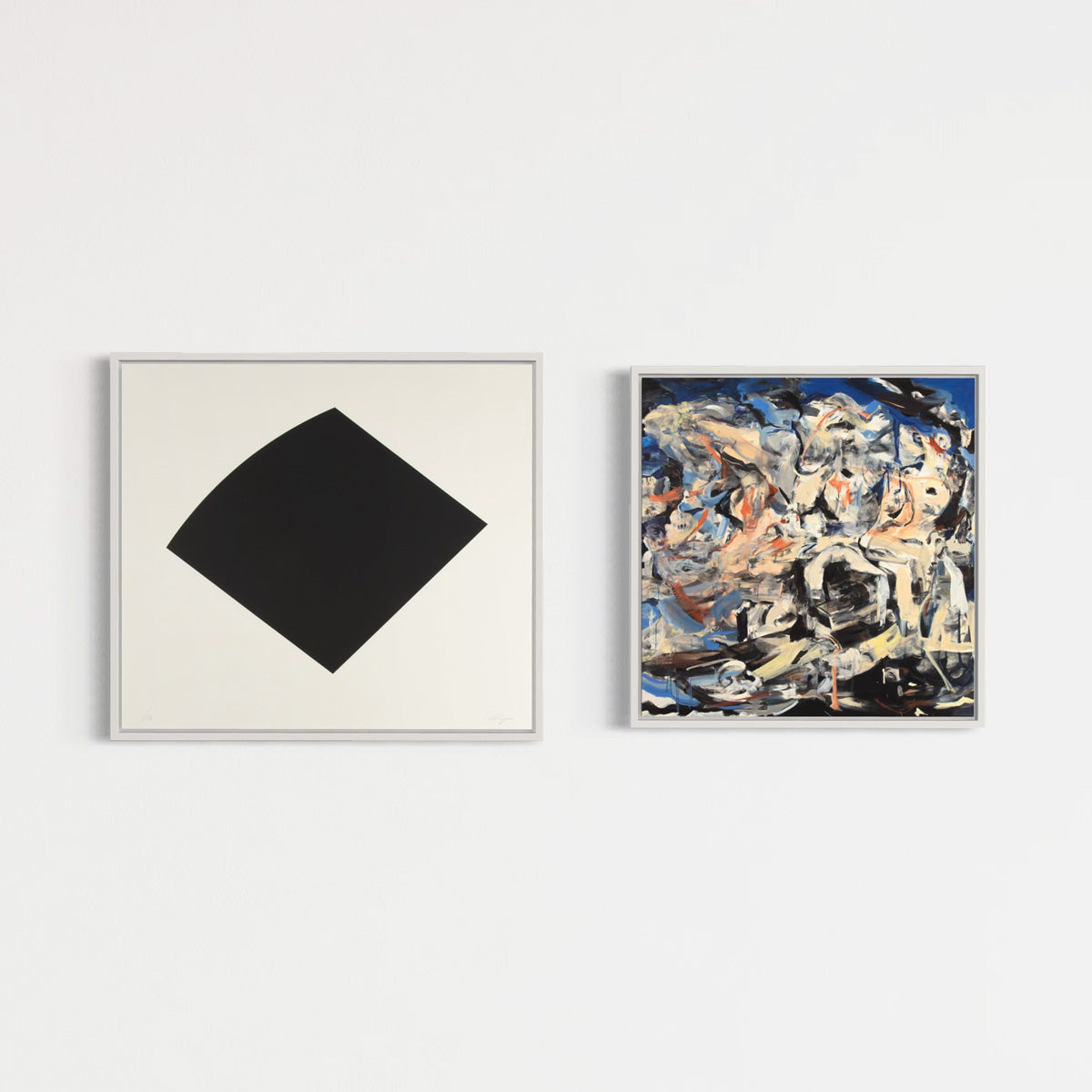
Among the consistently compelling are Ed Ruscha, whose works sit at the intersection of Pop and Conceptual art with decades of institutional depth; Peter Doig, one of the most significant figurative painters working today; Cecily Brown, whose market has strengthened steadily across two decades; and Wolfgang Tillmans, whose photographs occupy a unique position within the contemporary canon. All share the defining characteristic of blue-chip markets: institutional depth, sustained collector recognition, and consistent results across economic cycles.
The category spans genres as much as artists — from abstract prints with strong institutional backing to photographic editions, which have historically traded at a discount to painting despite comparable museum presence, making them an often underpriced entry point within blue-chip collecting.

The Limited Edition Print Market in 2026
According to ArtTactic's most recent Global Art Market Outlook, 43% of respondents expressed the highest level of confidence in blue-chip artists over the coming twelve months — the strongest rating across all market segments. Recent results are consistent with that conviction: Lichtenstein's Nudes at Sotheby's 2024 Evening Sale more than doubled the previous series record; Phillips' Evening & Day Editions sale achieved a 90% sell-through rate. Works priced under $5,000 have surged 79% since 2020. Browse our Art Under €2,500 and Affordable Blue-Chip Art selections to see that segment directly.
The honest picture includes risk. Overall art market sales fell 6.2% in the first half of 2025, and rising correlation with financial markets means a sustained downturn would register here too. Not every print marketed as investable actually is. But for the collector who selects on artist market depth, image significance, condition, and transaction history, the structural advantages of this category remain genuinely compelling. The best blue-chip prints are not merely scarce — they are tradable, measurable, and built for the long run.
|
Key Takeaways 1. Artist market depth matters more than fame. The most recognisable names are not always those with the most active secondary markets. 2. Look for consistent resale patterns, not headline results. Repeatable transactions within a rising range are the only honest signal. 3. Condition is a primary value driver. Two impressions of the same work can trade at meaningfully different levels based on physical state. 4. Diversify within your art allocation. Several prints by different established artists is structurally more resilient than one unique work at equivalent cost. 5. Know your exit route before you buy. Private sales increasingly outperform public auction in the mid-market. |
Questions about collecting as an investment? Get in touch
Liquidity and transparency are what separate investment-grade art from the rest.
Selected questions on this topic, its key figures, and its editions.
Investing in Art Prints and Editions: Key Questions


