





Collector Insights · Value & Condition
Edition Size Matters Less Than You Think
It is the first thing most buyers ask about, and it is rarely the most important answer. An edition of 25 by an artist with no active secondary market is harder to sell than an edition of 200 by an artist collectors pursue.
Edition size matters most as a relative figure — small for that artist, at that moment in their career. Marcel Dzama's 2004 debut portfolio ran to 26 impressions; later projects reached the low hundreds. The 26 are hard to find not because 26 is a small number in the abstract, but because they are early, and because the collectors who want them already own them.
Where edition size does bite is at the extremes. Runs under 20 rarely resurface at auction, which means less price evidence and a thinner exit. Beyond roughly 200, the market's language shifts: works at that scale are often classified as multiples rather than fine art prints, on the reasoning that the artist cannot have overseen each impression individually.
There is a point about numbering that gets overlooked in the argument about size. Whatever the figure, the fraction written on the sheet does work of its own: it ties that impression to a defined, finite run, it records the edition on the object itself rather than in a document that can be separated from it, and it makes comparison straightforward — 24/50 can be measured against every other impression of 50 that has traded. In that sense a numbered edition functions much like a catalogue raisonné entry. It is a form of documentation, and documentation is what makes a work easy to price and easy to sell.
There is one structural exception. A complete portfolio — all plates, intact, as issued — concentrates scarcity in a way individual sheets cannot, and consistently trades above the sum of its parts.

Proofs Are Not All the Same Thing
Alongside the numbered edition sit impressions marked with letters. They are not interchangeable, and they are routinely misread.
| Marking | What it is | Effect on price |
|---|---|---|
| Numbered | The regular edition, e.g. 24/50 | The reference price against which everything else is measured |
| A/P | Artist's proof — historically the artist's own copies, usually up to 10% of the edition | Frequently offered at a premium, though specialists often price it level with a numbered impression. Individual collectors have preferences; these do not reliably move price |
| EA | Épreuve d'artiste — the French designation for an artist's proof | The same category as A/P, not a separate one. Priced identically |
| H/C | Hors commerce — outside the trade, for publisher or workshop | Typically in line with the numbered edition |
| P/P | Printer's proof — for the workshop that produced the artwork | Scarce, and often sold at a modest premium — largely because they tend to surface only once the regular edition has sold out |
| T/P | Trial proof — pulled while the artist was still testing the image | Frequently priced well above the regular edition, since each trial differs and no second example exists. The range is wide and depends entirely on documentation |
| BAT | Bon à tirer — the impression the artist approved as the standard for the run | Unique by definition. The most sought-after proof type |
A proof marking is a claim, not a value. In practice the letters on the sheet move price far less than collectors expect — a high or low edition number does not either. What matters is the documentation behind the designation and whether buyers in that particular artist's market treat it as meaningful.
There is one situation where the premium becomes real, and it is worth understanding because it is often misread. When a numbered edition sold out years ago and a small number of proofs are the only impressions still reaching the market, those proofs can command a significantly higher price. The premium is genuine — but it comes from the scarcity of the edition as a whole, not from the letters. The same proof, offered while the numbered edition was still available, would not have carried it. Full definitions sit in our glossary of editions.

Technique and Scale — and Why They Fade
How a print was made is a value factor, but a time-limited one, and understanding why explains a good deal about how prices settle.
Labour-intensive processes cost more to produce. A screenprint built from twenty separately registered colour layers took twenty passes through the press, each one an opportunity to ruin the sheet. Large formats, roughly beyond 60 × 100 cm, require presses, paper and handling that few workshops can supply. The publisher prices that difficulty into the edition, the first buyer pays it, and it is passed on to the next.
But production cost is a primary-market factor, and its influence decays. The further a work travels from the year it was published, the less the market cares what it cost to make and the more it is priced on the things that endure: the artist's standing, the significance of the image, how scarce impressions have become, and the condition of the specific sheet. A technically remarkable print by an artist nobody follows does not hold its issue price because it was difficult to produce.
What does carry forward is the record. An edition from an established workshop with documented production is easier to verify and easier to sell, not because the paper is better but because the evidence exists. Our guide to understanding digital prints sets out what each process actually is and how the terms are used.

Condition Is Where the Money Goes
This is the factor that separates two otherwise identical impressions, and the one most buyers underweight. High-resolution photography has made it harder to overlook: issues that once went unnoticed in a saleroom are now examined at pixel level before anyone bids.
|
Trimmed margins Not reversible |
The sheet was cut down to fit a frame. This is the most serious issue on the list: the loss is permanent, immediately visible to any specialist, and it can reduce the value of an otherwise desirable impression substantially. |
|
Light-staining Effectively not reversible |
Paper darkens where it was exposed and stays pale under the mat, leaving a visible rectangle. The effect on price is significant, and more pronounced on large formats where the line runs across the whole sheet. |
|
Foxing Partially reversible |
Rust-coloured spots caused by humidity and impurities in the paper. How much it costs depends on density and position: scattered spots in the margin are a minor matter, spots across the image are not. |
|
Mat burn Not reversible |
A brown line where acidic mounting board touched the sheet. The effect on price ranges from moderate to significant, depending on how far the discolouration reaches into the image area. |
|
Hinge residue Partially reversible |
Remains of old mounting adhesive, usually on the reverse. The effect on price is minor, but it distinguishes the sheet from one in mint condition that has never been framed — and that distinction is the one buyers pay for. |
|
Handling creases Rarely reversible |
Soft creases and corner marks from being moved, stored or framed over the years. Very common, and the effect on price is small rather than decisive — the older the sheet, the more the market accepts them as part of its history. |
|
Pressure marks Partially reversible |
Impressions left in the sheet by stacking or framing clips. Barely noticeable on textured papers, clearly visible on smooth ones, and priced accordingly. |
|
Over-restoration Not reversible |
Earlier intervention beyond what was necessary, often undocumented. Increasingly serious: the market now prefers an honest sheet with a visible flaw to a cosmetically improved one with an unrecorded history. |
Before buying on the secondary market, ask for a condition report. A flawed impression is not automatically a bad purchase — it is a different purchase, at a different price, and it should be priced accordingly rather than quietly presented as pristine.

What a Signature Actually Proves
Not all signatures are equal, and the distinctions are worth knowing before paying for one.
A hand-signed print carries the artist's signature in pencil, applied to the sheet after printing. A plate-signed print reproduces a signature that formed part of the printed image — it was printed, not written, and adds little. An estate stamp is applied posthumously and carries real authority, though generally less market weight than a lifetime signature.
For several artists, signed and unsigned impressions function as parallel markets rather than as a simple premium: different buyers, different price levels, different liquidity. And signing editions only became standard practice during the twentieth century, which means many historic impressions are unsigned without that saying anything about their authenticity.
One distinction causes more confusion than any other. Artists have always signed things outside their editioned work — posters, exhibition announcements, catalogues, invitations — and Warhol, Christo and Beuys all did so readily. A signed poster is a real object with a real signature, and it is worth considerably more than the same poster unsigned. But it is not an edition from the artist's catalogued body of work, and the two should never be priced as though they were. The clearest test is whether the work appears in the artist's catalogue raisonné — which is where documentation comes in.
The honest qualification: a signature confirms the artist handled the sheet. It does not confirm condition, it does not confirm the edition is what it claims to be, and it does not make an unremarkable image remarkable.
Provenance, Certificates and the Catalogue Raisonné
Documentation does not add value so much as protect it. An impression with a clear ownership history, a publisher's certificate and a reference number in the artist's catalogue raisonné is straightforward to sell. The same impression without paperwork is not worth less in principle — it is worth less in practice, because the next buyer has to price in the uncertainty.
The catalogue raisonné reference is the strongest single document. It places the work inside the artist's authorised body of work, with edition size, technique and dimensions recorded by someone other than the seller. A blind stamp — the embossed mark of the publisher or workshop, pressed into the margin — is a second form of evidence, and one that cannot be added after the fact.

Not Every Image Is Equal
Within a single artist's output, certain images carry the career and others do not — and the market knows the difference precisely.
David Shrigley's signed prints typically trade between €2,000 and €6,000. Untitled (It's OK) reached $44,100 at Sotheby's in 2016, more than ten times its estimate. Same artist, same medium, same market. One image had become the one people wanted.
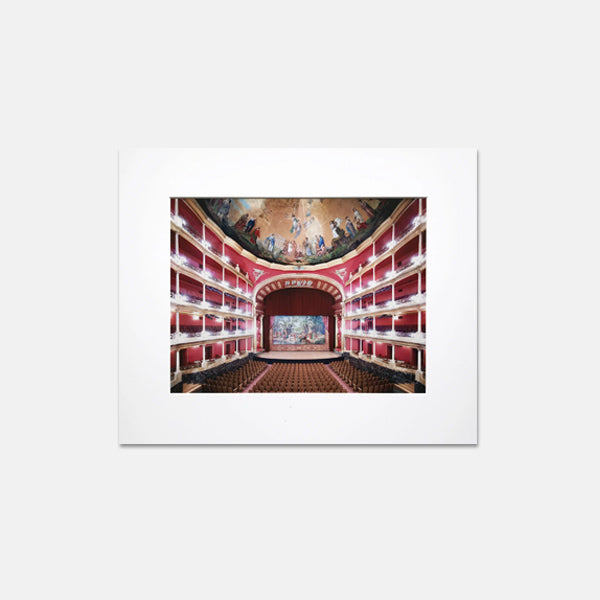
Format can do the same work. Candida Höfer issues her large-scale photographs in editions of two to six and smaller formats in larger runs. The same photograph can therefore exist at €2,000 and at a figure many times higher, differing only in scale and rarity.
There is a related behaviour worth understanding, because it limits how far any single image can run: buyers substitute. Within a well-known series, a collector who finds one impression overpriced will often move sideways to another from the same body of work rather than pay up. That elasticity is why a record result for one sheet does not automatically lift the rest.
This is why "I want a Richter print" is not yet a decision. Which Richter print is the decision.

The Market Around the Work
Everything above describes the object. The rest of the price comes from the market surrounding it — and this is the part that rarely gets explained.
An edition that is gone behaves differently from one that is available. While impressions remain with the publisher, the price is set and anyone can have one. Once the edition sells through, no further impressions can exist, and price is decided by whoever currently owns one and what the next buyer will pay.
That transition compounds over time. An edition of 100 that sold out forty years ago is not a run of 100 in any practical sense — it is a run of however many impressions actually reach the market in a given year, which might be two. Collectors who own one have no reason to sell; those who want one wait. When a sheet does surface, the factors above come into play with real force, because there is no second example to compare it against next month. Condition, documentation and proof status matter most precisely where supply is thinnest.
Liquidity does not drive the price so much as the willingness to pay it. A buyer commits more readily to a work they know they could sell again quietly in a year, to a buyer who already exists. That confidence does not push the number up by itself, but it makes the purchase easier to make — and over time, an artist whose editions are straightforward to resell attracts collectors that a thinner market does not.
An asking price is not a value. A work listed publicly at a given figure records an expectation. That expectation is usually built on the factors above and is often reasonable — but works remain advertised for years after serious demand has moved elsewhere, and an asking price is evidence of what someone hopes to receive, not of what anyone paid.
It is worth saying plainly that pricing rare works is an inexact science. Where an artist's reputation is expanding — a major museum show, a critical reassessment, a widening international audience — future expectation gets priced into present asking levels, in much the same way an elevated price-to-earnings ratio prices a company's expected growth rather than its current results. Sometimes that expectation is met. Sometimes the premium quietly disappears. The most reliable number available is still what a comparable impression last actually sold for.

Five Ways Collectors Lose Value Without Noticing
| 01 | Hanging it in daylight. Direct sun fades pigment and darkens paper within a few years. Indirect daylight does the same, slowly. |
| 02 | Non-archival framing. Most avoidable damage is done here. Mounting the sheet beneath a mat rather than floating it produces the light-stained rectangle described above within a few years. Hinging tape that is not acid-free and not water-soluble leaves residue that cannot be removed without intervention. Acid-free board, reversible hinges and UV-filtering glazing cost a fraction of what they protect. |
| 03 | Trimming to fit. Never. A frame can be made to fit a sheet; a sheet cannot be made to fit a frame without permanent loss. |
| 04 | Losing the paperwork. Certificates, invoices and condition reports are part of the asset. Store them with the work. |
| 05 | Dry-mounting. Permanently adhering a sheet to a backing board removes almost all of its market value. It is still done, usually by people trying to be helpful. |
What This Means When You Buy
The questions worth asking before any purchase are short. What is the edition size, and is this a numbered impression or a proof? What is the condition, specifically, and have the margins been touched? Is it hand-signed? What documentation comes with it? And is this image one the artist is known for, or a minor work from the same period?
A seller who answers all five without hesitation is telling you something about the work and about themselves. Every signed limited edition print in our collection carries that information stated plainly, because the alternative is asking a buyer to take it on trust.
For the market-level view — returns, liquidity and how editions behave as an asset class — see our guide to investing in prints and editions.

|
Key Takeaways 1. Edition size alone decides very little. Scarcity concentrates demand that already exists; it does not create it. 2. Condition separates two identical impressions. Trimmed margins and light-staining cannot be undone, and they are immediately visible. 3. A proof marking is a claim, not a value. What counts is whether documentation supports it. 4. An edition that sold out decades ago is scarcer than its number suggests. What matters is how often an impression actually reaches the market. 5. An asking price is not a value. What a comparable impression last sold for is the number that matters. |
Questions about a specific print? Get in touch
An artist's standing creates the demand. Scarcity only concentrates what is already there.
Selected questions on this topic, its key figures, and its editions.
What Makes a Print Valuable?: Key Questions


