
Art Movement Insight
The Object That Refused to Be Reduced
Donald Judd had already made his case in writing before Primary Structures opened. His 1965 essay "Specific Objects," published in Arts Yearbook 8, argued that a new kind of work had emerged — neither painting nor sculpture, existing instead in real, three-dimensional space rather than the illusionistic space of a canvas. "Actual space is intrinsically more powerful and specific than paint on a flat surface," he wrote, challenging the illusionistic tradition that had dominated painting for centuries.
Judd meant the argument literally. From 1964 onward, he stopped fabricating his own work, instead sending drawings to industrial manufacturers — most notably the Bernstein Brothers metal shop — and having his "stacks" and "boxes" built to exact specification. Removing his own hand from construction was not a shortcut; it was the entire point, a direct rebuke to the idea that authenticity required visible authorial touch.
When Primary Structures opened that April, Carl Andre's most provocative contribution was Lever: a row of 137 ordinary firebricks laid flat, extending in a straight line from the wall across the gallery floor. Visitors were baffled and, in some cases, openly annoyed — the materials were available at any building supply yard, assembled with no visible skill at all. That was precisely Andre's point: if anyone could physically make the work, then the art had to be located somewhere other than craft or virtuosity — in the decision, the placement, the idea.

Key Minimalist Artists
Sol LeWitt pushed Judd's logic to its most radical conclusion. Rather than fabricating objects himself or through hired manufacturers, LeWitt reduced the artwork to a written instruction — a wall drawing existed as a set of rules that assistants, often working long after LeWitt's own involvement had ended, carried out on his behalf. Explore Sol LeWitt's editions →
Dan Flavin turned commercially available fluorescent light tubes — the same fixtures found in any hardware store — into a complete sculptural vocabulary, using industrial material to activate colour, shadow, and architectural space directly, with nothing added or altered. Explore Dan Flavin's editions →
Robert Morris moved fluidly between theory and practice, writing the influential 1966 essay "Notes on Sculpture" while producing plywood boxes and mirrored cubes that had begun, unusually, as stage props for a ballet company — a reminder that Minimalist art's rigour emerged from genuinely varied, sometimes accidental origins.

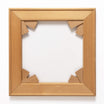
Fred Sandback arrived at Minimalism by way of stringed instruments — as a teenager in Bronxville, New York, he built banjos and dulcimers before studying philosophy and sculpture at Yale, where Judd and Robert Morris taught as visiting instructors. In 1967, Sandback created the sculpture that defined his career: using taut wire and string, he outlined the exact shape of a twenty-foot wooden board lying on the floor, then removed the board itself, leaving only its ghost in space. He later replaced wire with coloured acrylic yarn, building room-filling geometric planes from a material more commonly associated with craft than sculpture. Explore Fred Sandback's editions →
Robert Mangold applied Minimalist reduction to painting itself, developing monochromatic, irregularly shaped canvases that treated the edge of the support as an active part of the composition rather than a neutral boundary. Explore Robert Mangold's editions →

Richard Serra emerged directly from this circle in the 1960s but pushed against its central premise as much as he absorbed it. Where Judd and Morris treated the surrounding gallery largely as a neutral space the work could activate, Serra folded gravity and physical force into the sculpture's own structure — One Ton Prop (House of Cards), four half-tonne lead sheets balanced against each other by weight alone, quite literally depends on forces Minimalism had never needed to reckon with directly. Most historians now place him at the hinge between Minimalism and the Post-Minimalist, process-based sculpture that followed. Explore Richard Serra's editions →
Painters including Ellsworth Kelly and Carmen Herrera are frequently discussed alongside Minimalism for closely related reasons — hard-edge colour, shaped canvases, a rejection of gesture — though their roots lie more directly in earlier geometric abstraction than in Judd's specific-objects lineage. Painters such as Robert Ryman and Agnes Martin occupy similar adjacent territory, reducing painting to near-monochrome fields and grids while resisting the Minimalist label themselves. The overlap across all of these figures is real, but the histories are not identical.

Why Does Minimalism Matter?
Minimalist art matters because it permanently changed what a work of art was allowed to be made of, and who was allowed to make it. Before Judd and his contemporaries, the assumption that an artist's own hand had to physically shape a work — brushstroke, chisel mark, personal gesture — was rarely questioned outright. Minimalism broke that assumption deliberately and publicly, arguing that a work's authenticity lay in its concept and placement, not in visible craft.
The movement also permanently widened where art could exist. By insisting that a sculpture's relationship to the room around it — its scale, its shadow, the viewer's own body moving past it — was part of the work itself, Minimalism made architectural space an active material rather than a neutral container. Every white-cube gallery built since the late 1960s, every museum that treats empty space as a deliberate design choice, carries that argument forward, often without visitors realising where the idea originated.

How Has Minimalism Influenced Contemporary Art?
Minimalism's influence runs through contemporary art along several distinct paths. The first is direct lineage: Sol LeWitt's insistence that an idea could generate a work without the artist's hand fed straight into Conceptual Art, and from there into a wider culture of instruction-based and process-driven practice that continues today. Imi Knoebel's reduced geometric forms and use of raw materials developed in direct dialogue with Minimal Art, while remaining deeply rooted in Malevich and the Düsseldorf context around Joseph Beuys — a German inheritance of the same core conviction.
A second path runs directly through critique. In 1986, Peter Halley and a cohort of New York artists launched what became known as Neo-Geo, borrowing Minimalist geometry and flat colour fields wholesale, then repurposing that vocabulary to diagnose something Judd and Flavin had never addressed directly: the isolating, cellular geometry of modern urban and technological life. Halley's paintings function almost as a rebuttal written in the original movement's own visual language.

A third path runs through fabrication itself. Judd's decision to outsource construction to industrial manufacturers anticipated a working method now standard across contemporary art. Wade Guyton's use of commercial inkjet printers can be read as a contemporary extension of Minimalism's interest in mechanical production, repetition, and the removal of traditional artistic gesture — the machine as fabricator, precision standing in for the artist's touch. Fred Sandback's spatial investigations, meanwhile, are widely credited with anticipating the immersive, room-scale installation art that now dominates major biennials and museum commissions worldwide.
The Legacy of Minimalist Art
Donald Judd never stopped objecting to the word that made his career legible to the wider public. "I don't think anyone's work is reductive," he insisted, decades after Primary Structures had already made him the movement's most recognisable name. That argument — between what critics needed to call something and what the artists themselves believed they were doing — never fully resolved. It didn't need to. Sixty years on, Minimalism's central proposition remains intact: that a plain object, placed with total precision in real space, can carry as much weight as anything painted, carved, or gestured into being.
Actual space is intrinsically more powerful and specific than paint on a flat surface.
Selected questions on the artist’s practice, major artworks, and editions.
Minimalism: The Art Movement That Refused Its Own Name: Key Questions


