





Art Movement Insight
The Bechers: From Advertising Agency to Anonymous Sculptures
Bernd Becher trained first as a painter at the Stuttgart Academy, then studied typography under Karl Rössing at the Kunstakademie Düsseldorf from 1959 to 1961 — an unusual background for a photographer, but one that shaped everything that followed. Typography trains the eye to notice grid, repetition, and precise formal variation within a fixed system; Becher later applied exactly that logic to industrial architecture, treating a row of blast furnaces the way a typographer might treat a page of identically weighted letterforms. Hilla Becher, meanwhile, had completed a photography apprenticeship in her native Potsdam before continuing her studies in Düsseldorf. The two met in 1957, both then working as freelance product photographers for the Troost advertising agency, and married in 1961.

From 1959, the couple began systematically documenting Europe's disappearing industrial architecture — water towers, coal bunkers, grain elevators, blast furnaces — always shot frontally under overcast skies to eliminate shadow, always stripped of people, always from the same fixed distance. Bernd later explained the urgency behind the project directly: he had come to see these structures as a kind of nomadic architecture, often standing for less than a century before disappearing entirely. Their 1969 Düsseldorf exhibition, later published as the 1970 photobook Anonymous Sculptures, organised the resulting images into thematic categories — the pot, the oven, the chimney, the winch, the pump, the laboratory — treating each industrial form as what the Bechers explicitly compared to Marcel Duchamp's readymades: a found object, elevated to art through selection and framing rather than alteration.
The comparison to Duchamp was not incidental flattery. In 1990, at the 44th Venice Biennale, the Bechers were awarded the Golden Lion — not for photography, but for sculpture, an unusual category decision that formally acknowledged what the "Anonymous Sculptures" title had already argued: that a photograph, presented with sufficient rigour, could occupy the same critical space as an object in three dimensions.

Key Photographers of the Düsseldorf School
Bernd Becher was appointed Chair of Artistic Photography at the Kunstakademie Düsseldorf in 1976, formally founding the programme that would train the school's most consequential names.
Thomas Ruff took the Bechers' typological rigour and turned it toward the human face. Beginning in 1981, he photographed friends and fellow students in the deadpan conventions of a passport photograph — frontal pose, neutral expression, plain background — then, from 1986, enlarged the results dramatically, some prints reaching over two metres tall. At that scale, every pore, blemish, and stray hair becomes visible, an intimacy the small, official passport format was explicitly designed to suppress. Ruff would later apply the same principle — a photographic technology chosen deliberately to interrogate its subject — to a military night-vision device for his Nights series, and to deliberately compressed digital files for jpeg, each project testing what a specific medium reveals and what it quietly conceals.
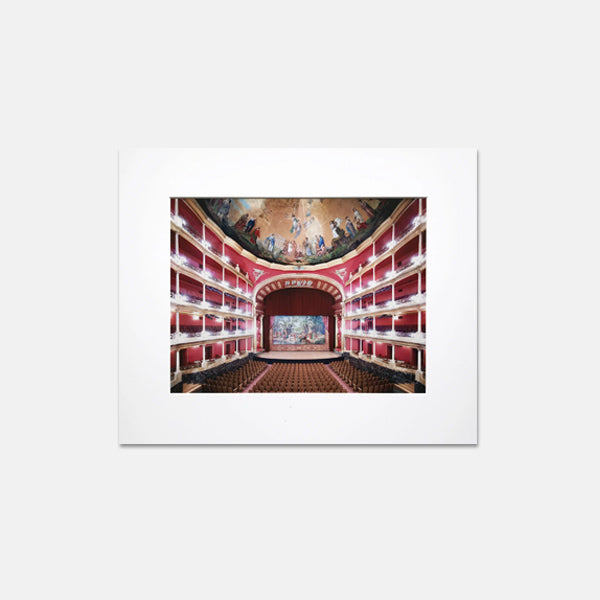
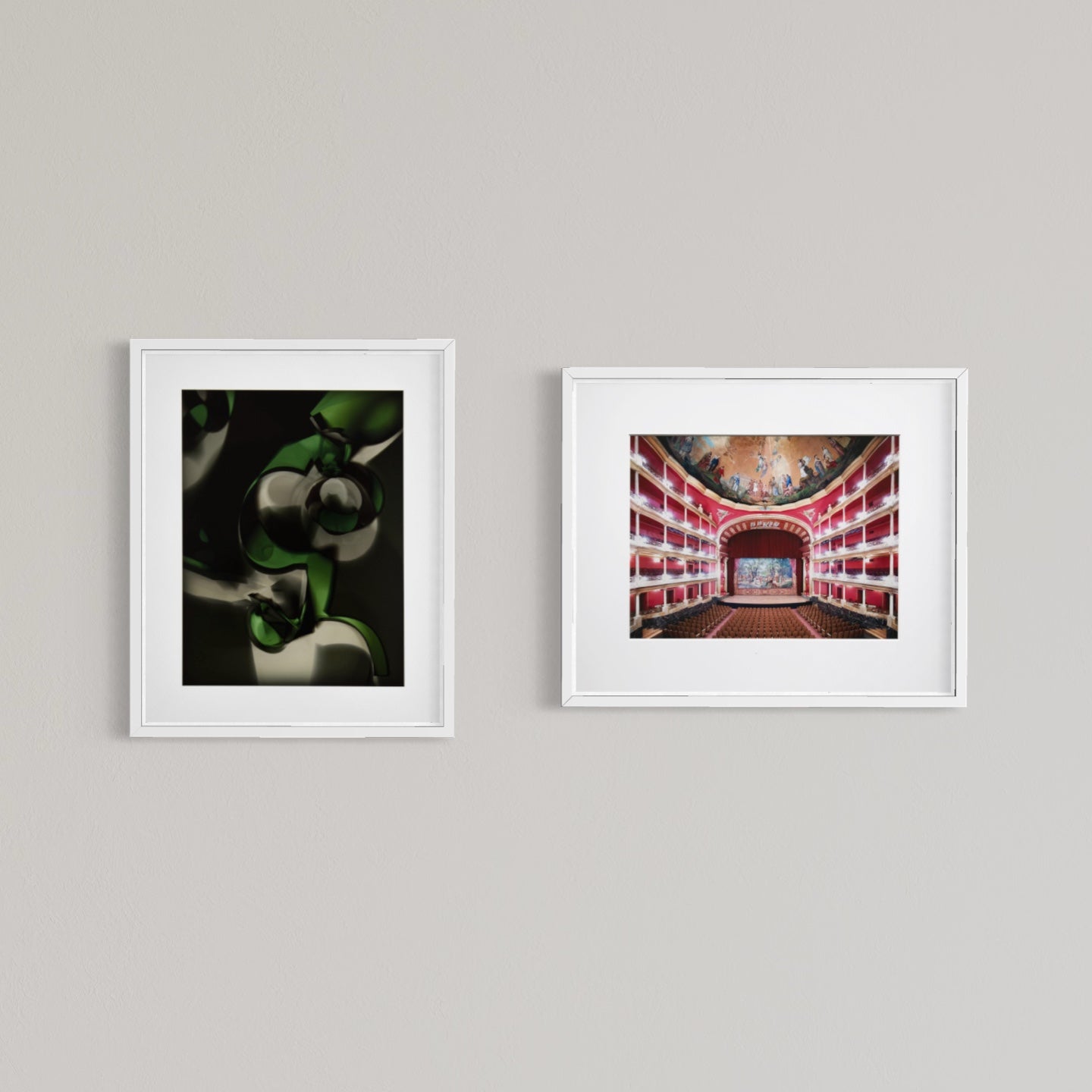
Candida Höfer turned the Bechers' frontal, unpeopled method toward interiors rather than exteriors — libraries, opera houses, museums, waiting rooms — photographed always in available light, without additional equipment, and always empty of visitors. Where the Bechers documented industry's disappearing structures, Höfer documented the quiet authority that institutional architecture exercises over the people who pass through it, whether or not those people are actually present in the frame.
Andreas Gursky pushed the Bechers' documentary detachment toward the spectacular. Trained first at the Folkwang School under Otto Steinert before studying with Becher from 1981 to 1987, Gursky photographed stock exchanges, supermarkets, and vast industrial interiors at a scale and digital precision that transformed everyday scenes into something closer to abstraction — patterns of colour and repetition legible from across a room, dissolving into overwhelming detail on close inspection.

Thomas Struth studied under both the Bechers and, separately, the painter Gerhard Richter — a dual education that shows clearly in his work. His early black-and-white Streets series applied Becher-style frontal, comparative photography to city thoroughfares across Europe and America; his later Museum Photographs turned the same patient, unhurried attention toward gallery visitors themselves, photographing people looking at paintings with a formal rigour Richter's own painting practice would have recognised immediately.
Thomas Demand studied sculpture under Fritz Schwegler at the same academy, but was also taught photography directly by the Bechers — a dual training that produced the school's strangest departure yet. Rather than documenting existing structures, Demand builds full-scale paper and cardboard replicas of real spaces, often tied to political history, photographs them once, and destroys the model immediately afterward. He has said he considers himself less a photographer than a conceptual artist for whom the camera is simply the final step — proof that the Bechers' rigour could produce not just documentary discipline, but its own radical opposite.

Axel Hütte, one of the earliest students in Becher's class (1973–1981), shares a converted power-station studio in Düsseldorf-Oberkassel with Gursky and Ruff, a working space the three photographers have occupied since the early 1980s. Hütte pushed the Bechers' conceptual rigour toward landscape and cityscape photography with an almost painterly quality — forests, mountains, and misted tower blocks composed with a formal restraint that borrows as much from abstract painting as from documentary tradition. In 1986, he and Ruff collaborated directly on some of the school's first large-format prints, working with a Düsseldorf advertising firm to scale their images to sizes the medium had rarely attempted before.
Elger Esser, born in 1967 and raised between Rome and Stuttgart, joined the Becher class a full generation later, in the 1990s, just as the school's first wave was achieving international fame. Rather than continuing the Bechers' documentary detachment, Esser turned toward pale, luminous landscape photography with deliberately low horizons and a historical, almost timeless quality — an approach his own gallerist has called a departure sharp enough to earn him the nickname "heretic" of the Düsseldorf School. His work is a useful reminder that the school's discipline produced not a single style, but a rigorous training ground diverse enough to hold both Ruff's cool detachment and Esser's romanticism within the same lineage.

Market Impact: From Classroom to Auction Record
For decades, photography sold for a fraction of what painting commanded — treated, even by serious collectors, as a supporting medium rather than a primary one. The Düsseldorf School's rise through the 1990s and 2000s upended that assumption entirely. On 8 November 2011, Andreas Gursky's Rhein II (1999) — an austere, digitally stripped-back view of the Rhine, nearly four metres wide — sold for $4,338,500 at Christie's New York, becoming the most expensive photograph ever sold at auction, a record it held for over a decade. Three further copies from its edition of six now hang in MoMA, Tate Modern, and Munich's Pinakothek der Moderne.
That single sale was not an isolated event; it confirmed what the Bechers had argued from their very first water tower, decades earlier: that photography, approached with sufficient conceptual discipline, belonged in the same conversation as painting and sculpture — not beneath it, and not secondary to it.

The Legacy of the Düsseldorf School
Nearly five decades after Bernd Becher's appointment, the school's influence remains difficult to overstate — not because it produced a single recognisable style, but because its training method proved rigorous enough to survive three generations pulling it in different directions. Höfer, Struth, Ruff, and Hütte inherited the Bechers' documentary detachment directly; Gursky pushed it toward spectacle and scale; by the 1990s, Elger Esser was testing how far the discipline could bend toward romanticism before it broke, and largely getting away with it.
That range shaped photography in three concrete ways. It became a serious academic discipline rather than a technical trade, rigorous enough to produce both Ruff's cool typologies and Esser's luminous landscapes from the same starting principles. It became genuinely collectible at painting-level prices, culminating in Gursky's record-breaking Rhein II sale. And it became a fixture of major museum programming, with retrospectives of Ruff, Gursky, Höfer, Struth, Hütte, Esser, and Demand now standard at institutions including MoMA, Tate, and the Centre Pompidou.
What began with two advertising photographers documenting water towers on cloudy afternoons became, within three overlapping generations, one of the most consequential and genuinely varied developments in the history of the medium.
Engineering constructions with their own aesthetic.
Selected questions on this topic, its key figures, and its editions.
The Düsseldorf School of Photography: Key Questions


