Kara Walker – Boo-Hoo


Kara Walker (American, b. 1969)

Boo-Hoo, 2000

Medium: Linocut on Arches Cover paper

Dimensions: 100.8 x 52.4 cm (40 x 20 1/2 in)

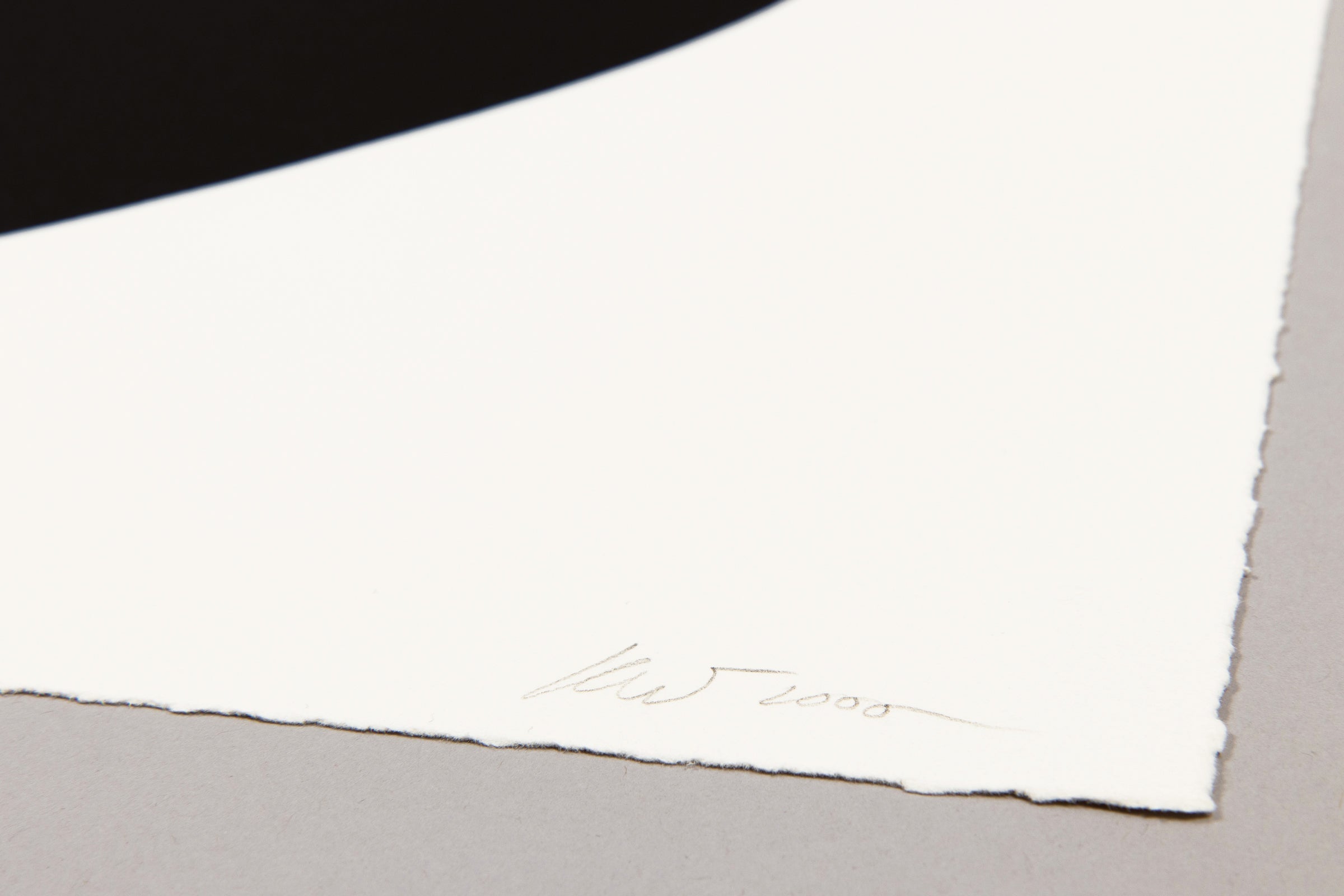
Edition of 70 + XXX: Hand-signed, titled, dated and numbered in pencil

Publisher: Parkett, Zurich and New York

Printer: Maurice Sanchez, Derrière L’Etoile Studio, New York

Literature: Parkett 59

Condition: Excellent

This artwork ships worldwide — fully insured.

About this artwork

Kara Walker – Boo-Hoo

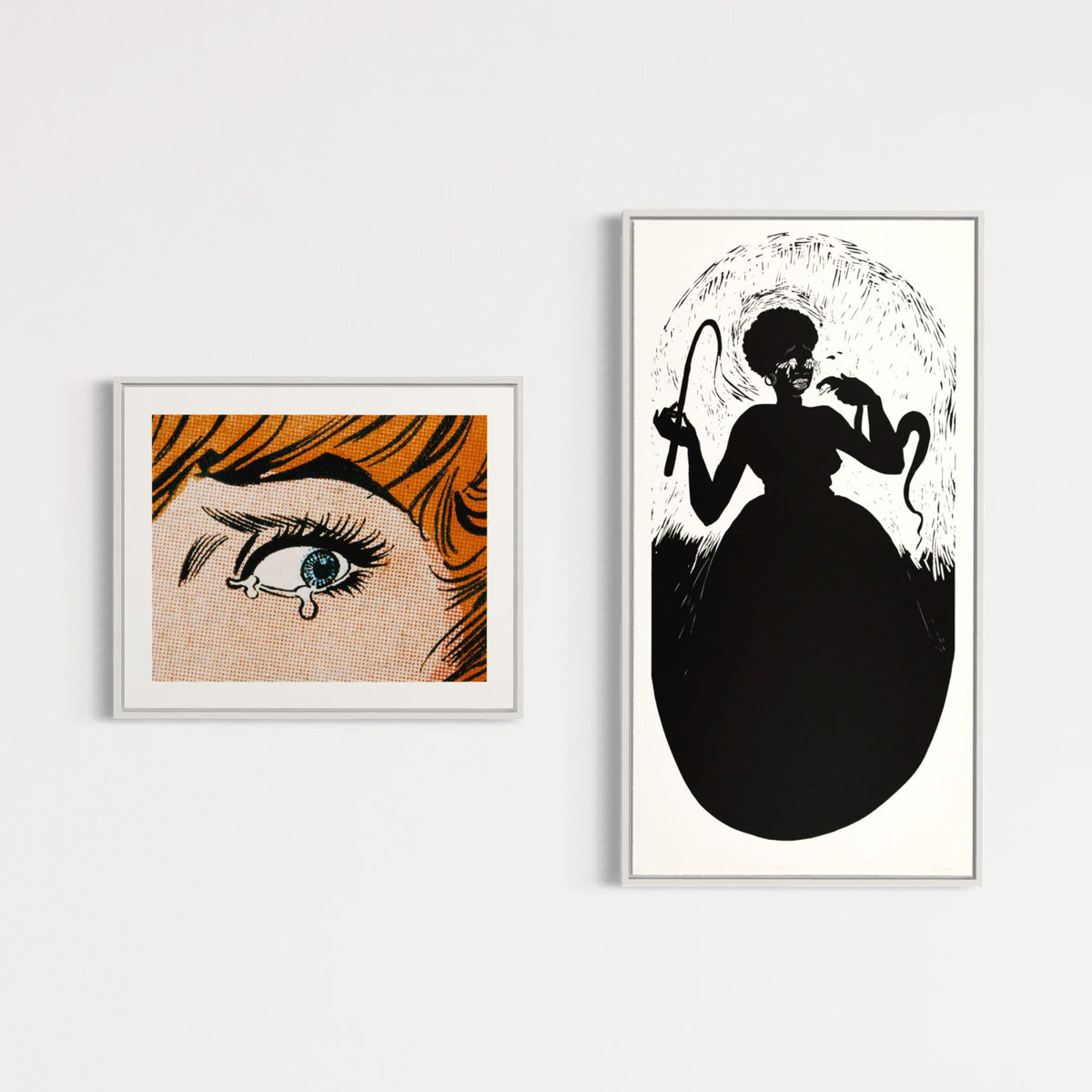
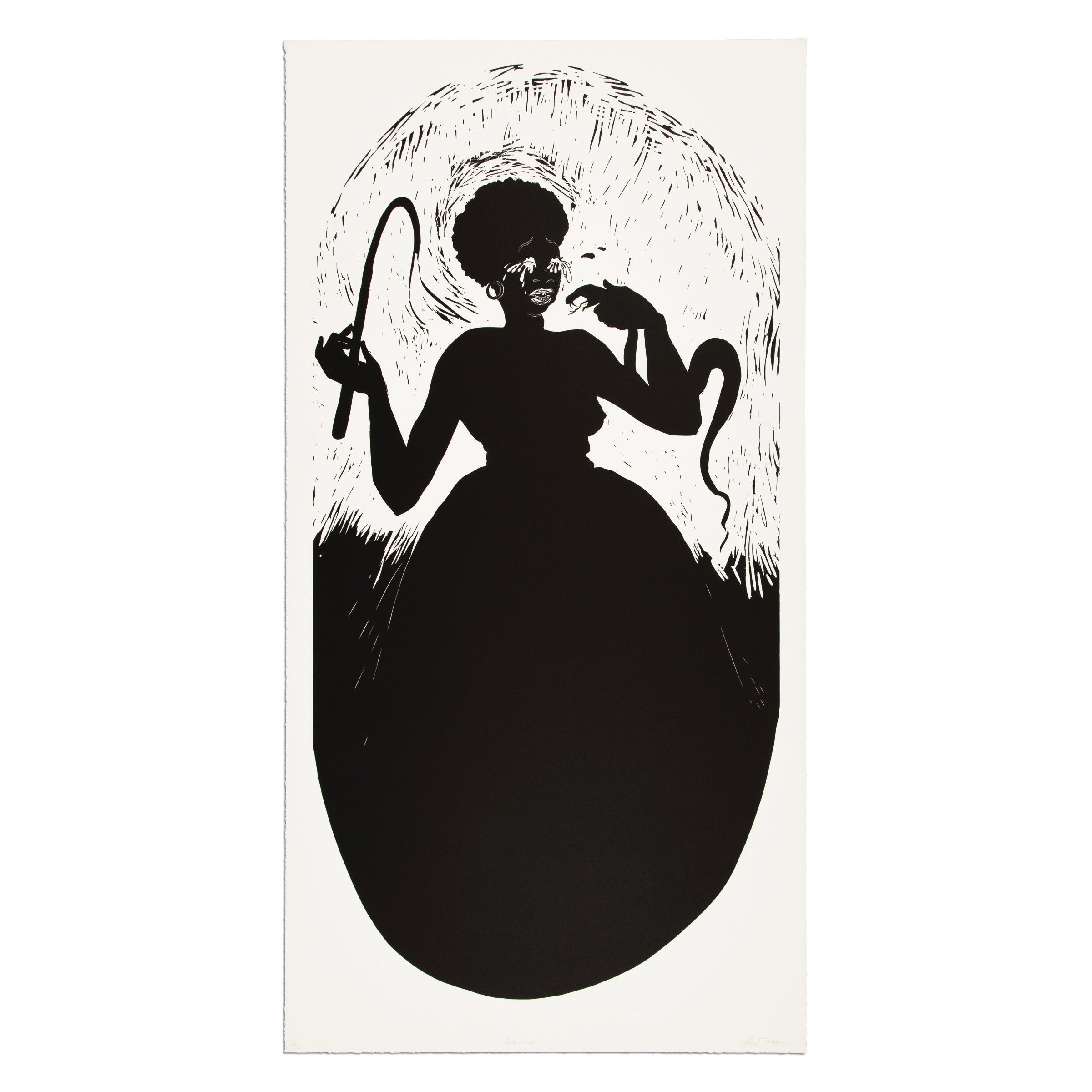
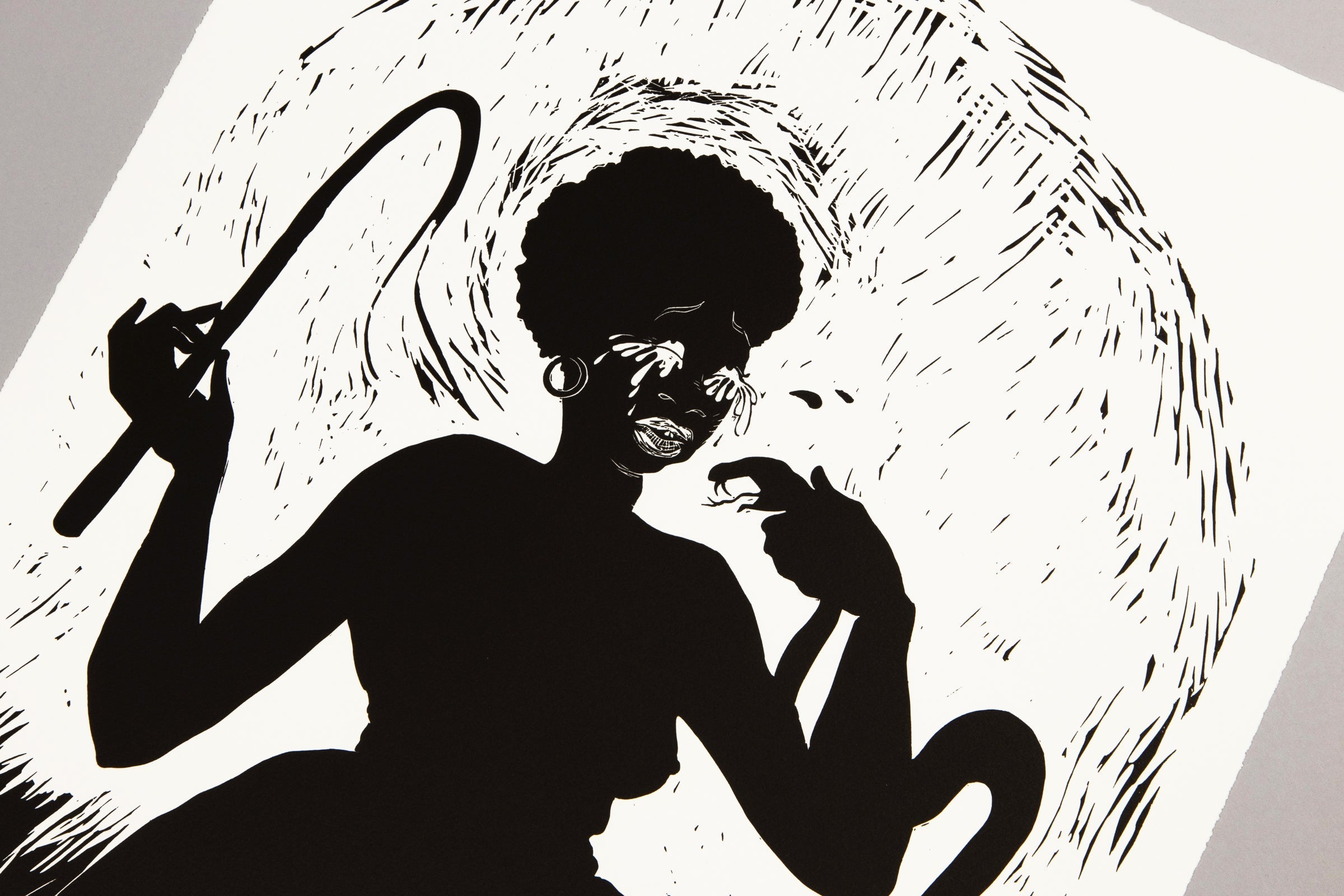
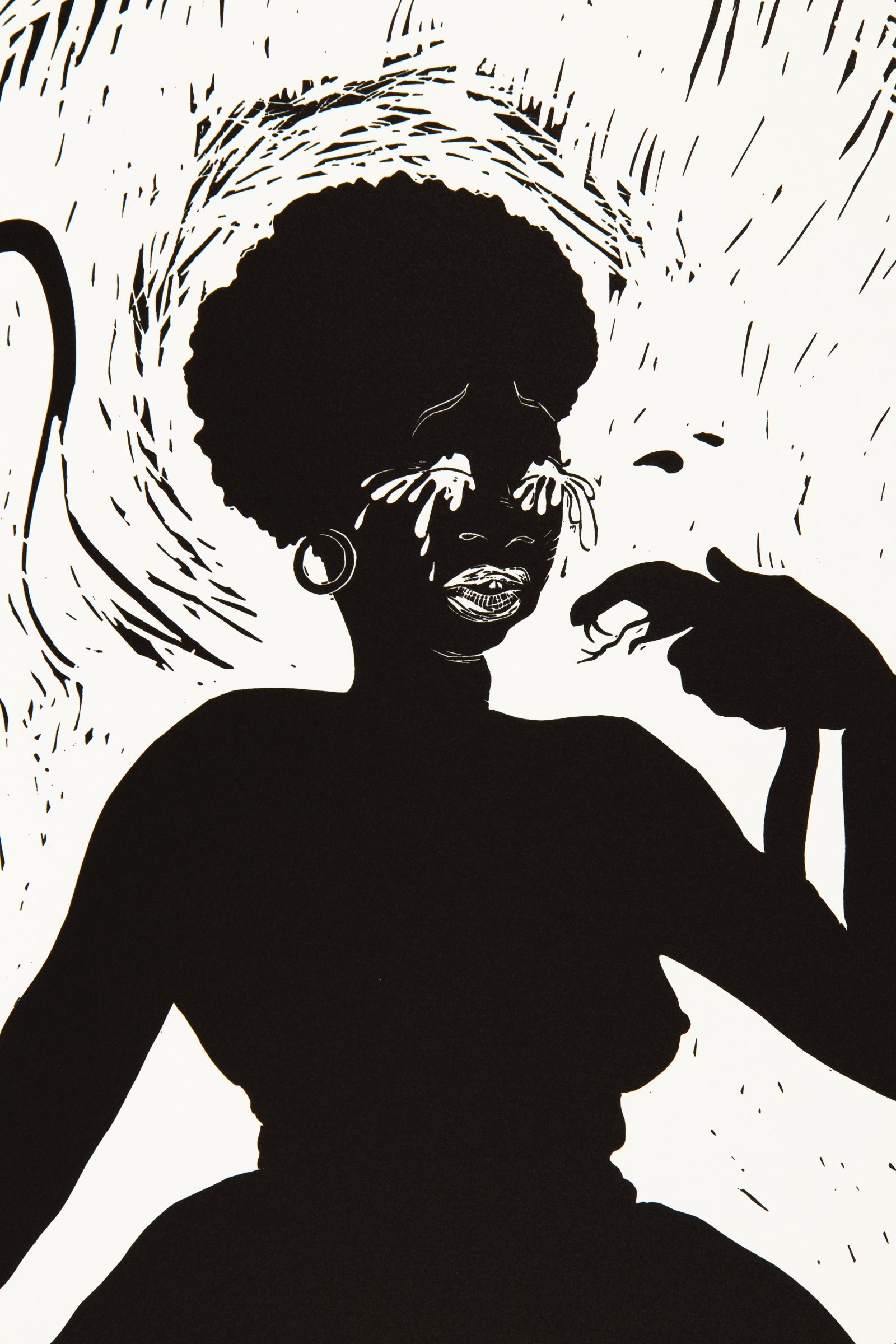
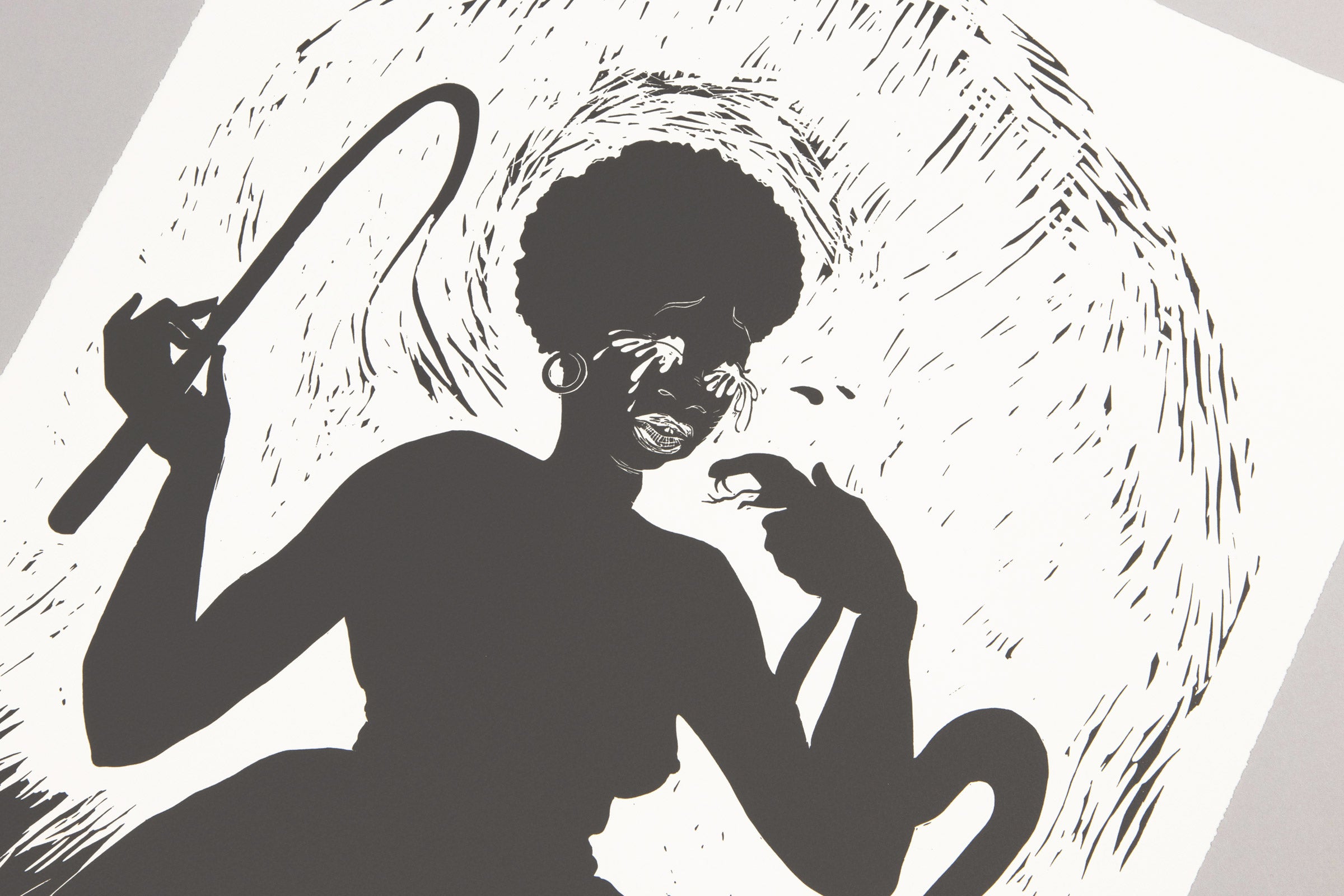
Kara Walker's Boo-Hoo (2000) is a seminal signed limited edition linocut that exemplifies the artist's role as one of the most incisive political artists working today. Rendered in stark black against a pale ground, the composition presents a monumental silhouetted female figure whose exaggerated tears transform into whip-like forms, collapsing the boundary between emotional expression and physical violence.

The specific imagery rewards close attention. The figure holds a whip — the defining instrument of slavery — but it is in her hand, not her master's, immediately destabilising any simple reading of victim and oppressor. The snake coiling around her arm invokes the Biblical Eve, and together the two objects deliberately echo one of the most damaging stereotypes imposed on enslaved Black women: the Jezebel, the seductress who "invited" her own abuse — the lie used for centuries to justify the systematic rape of enslaved women, transferring guilt onto the victim. Walker seizes that myth, renders it monumental, and forces the viewer to confront its ugliness. Meanwhile, the radiating lines behind her head give her the aura of a saint or a madonna, and the title Boo-Hoo — slang for dismissing someone's tears — names the very act of trivialising Black grief that the work refuses to allow.

Drawing on the visual language of 19th-century silhouette portraiture, Walker's choice of medium does further political work. The silhouette portrait was a parlour tradition, a genteel craft used by respectable white families to memorialise themselves. By seizing that form and filling it with the histories those families preferred not to see, Walker turns white culture's own visual language into a mirror — one that reflects back not refinement, but complicity. In Boo-Hoo, sentimentality becomes destabilising rather than consoling: grief turns confrontational, vulnerability merges with aggression, and the figure oscillates between victim and perpetrator. This ambiguity is central to Walker's practice, forcing viewers to confront uncomfortable histories rather than passively consume them.

Commissioned and published by Parkett in 2000 and printed by Maurice Sanchez at Derrière L'Etoile Studio, New York, this linocut underscores Walker's sustained engagement with printmaking as a direct and democratic medium for political critique. The physicality and scale of the fine art print intensify its impact, reinforcing the immediacy and urgency of its subject matter. Issued in a signed and numbered edition of 70 plus artist's proofs and documented in Parkett no. 59 — which framed the work around the question "Will There Be Any Black People in Utopia?" — Boo-Hoo stands as a defining example of Kara Walker's politically charged practice, in which history, race, and power are confronted through uncompromising visual form. The work entered MoMA's permanent collection in the year of its publication and is also held by the Whitney Museum of American Art.

Kara Walker – The Bush. Skinny. De-boning

About Kara Walker

Kara Walker is an internationally acclaimed American contemporary artist, celebrated for her provocative and visually arresting explorations of race, gender, power, and identity. Born in 1969 in Stockton, California, she rose to prominence in the mid-1990s with her groundbreaking silhouette installations, collages, and prints. By reimagining the traditional 19th-century silhouette technique, Walker developed a radical visual language that continues to challenge historical narratives and expose the enduring impact of racism in American society.

At the core of Kara Walker's work are her cut-paper silhouettes, often life-sized and arranged in expansive narrative tableaux. While the silhouette was historically associated with genteel portraiture, Walker subverts the medium's decorative quality, transforming it into a tool for confronting the darkest aspects of U.S. history. Her stark black-and-white scenes depict unsettling images of slavery, violence, and exploitation, forcing viewers to engage with the uncomfortable truths that underpin the nation's collective memory.

Beyond her iconic silhouettes, Walker has expanded her practice to include collage, painting, drawing, printmaking, and large-scale installations. Her limited edition prints in particular demonstrate her exceptional technical mastery, as she explores the tension between delicacy and brutality through line, shadow, and composition. These artworks maintain the bold visual clarity of her silhouettes while deepening the psychological and historical resonance of her narratives.

Kara Walker's art is both visually stunning and conceptually challenging. Through her fearless approach, she continues to provoke dialogue on issues of race, gender, and systemic inequality, cementing her role as one of the most important voices in contemporary art. Her signed lithographs, etchings, and screenprints, whether monumental installations or intimate editions, invite viewers to grapple with history's legacies while reflecting on the complexities of identity in the present.

Prints, Photographs & Multiples

View our full collection of

Prints, Photographs & Multiples

Shop now