










About Georg Baselitz
Georg Baselitz (b. 1938, Deutschbaselitz) is one of the most significant painters of his generation — a defining figure in Neo-Expressionism and a towering presence in postwar European art. His work confronts the wreckage of German history head-on: the trauma of the Second World War, the fracture of national identity, and the question of what it means to paint at all in its aftermath.
In 1969, Baselitz began painting his subjects upside down — a radical decision that remains his most recognisable formal gesture. The inversion is not a stylistic trick but a philosophical one: by severing image from meaning, he forces the viewer to experience painting as pure form before narrative takes hold. The figure is still there, but disoriented — suspended between recognition and abstraction, familiar and strange. It is an act of deliberate disruption that has lost none of its force.
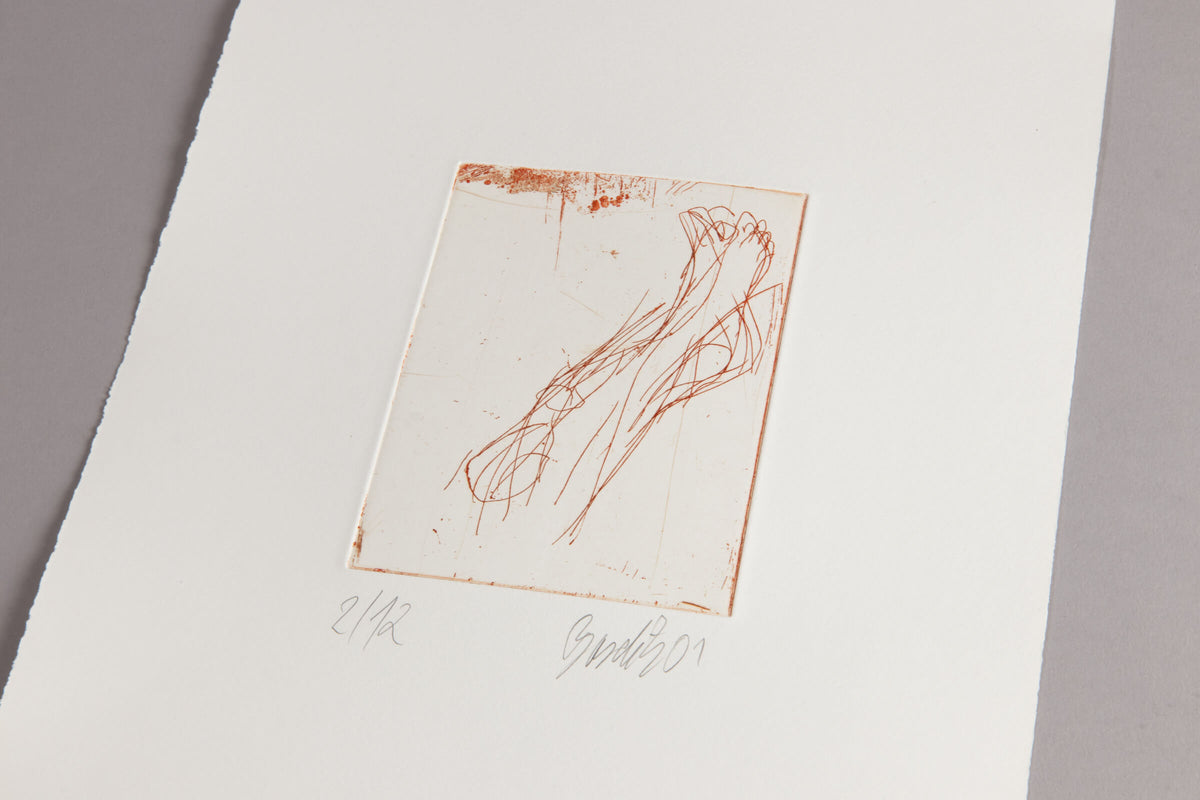
His imagery draws from a wide range of sources — Soviet-era illustration, Mannerist painting, African sculpture, and the raw expressionism of the German tradition — synthesised into a visual language that is entirely his own. Across paintings, monumental sculptures, and a significant body of prints and editions, Baselitz has consistently argued for the continued vitality and urgency of painting as a critical medium.
Major solo exhibitions include the Royal Academy of Arts, London (2007), the Hirshhorn Museum and Sculpture Garden, Washington D.C. (2018), and the Albertina Museum, Vienna (2023). His work is held in the permanent collections of MoMA, the Tate, the Centre Pompidou, and the Guggenheim, among others.


