




About Georg Baselitz
Georg Baselitz (1938–2026), born Hans-Georg Kern in Deutschbaselitz, Upper Lusatia, was one of the most consequential painters of the German post-war era. Across painting, sculpture, and printmaking, he built his practice on one radical gesture: painting subjects upside down, stripping figuration of its illustrative authority.
Baselitz enrolled at an East Berlin academy in 1956 and was expelled after two semesters for "sociopolitical immaturity." He continued in West Berlin under Hann Trier, graduating in 1962. His 1963 debut exhibition caused scandal: two paintings, including Die große Nacht im Eimer, were seized by prosecutors on obscenity charges in a case that ran until 1965.
His Helden (Heroes) paintings of the mid-1960s, shaped by a 1965 scholarship to Florence and its Mannerist prints, depicted battered figures against the wreckage of postwar Germany. The Fracture paintings that followed split human and animal forms across the canvas, mirroring the nation's divide. In 1969 he began inverting his subjects outright, detaching image from representation to force attention onto structure and material. Influences ranged from Soviet illustration and Mannerism to art brut, Antonin Artaud, and the African sculpture he collected.
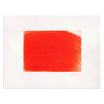
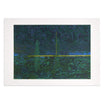
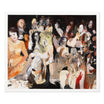
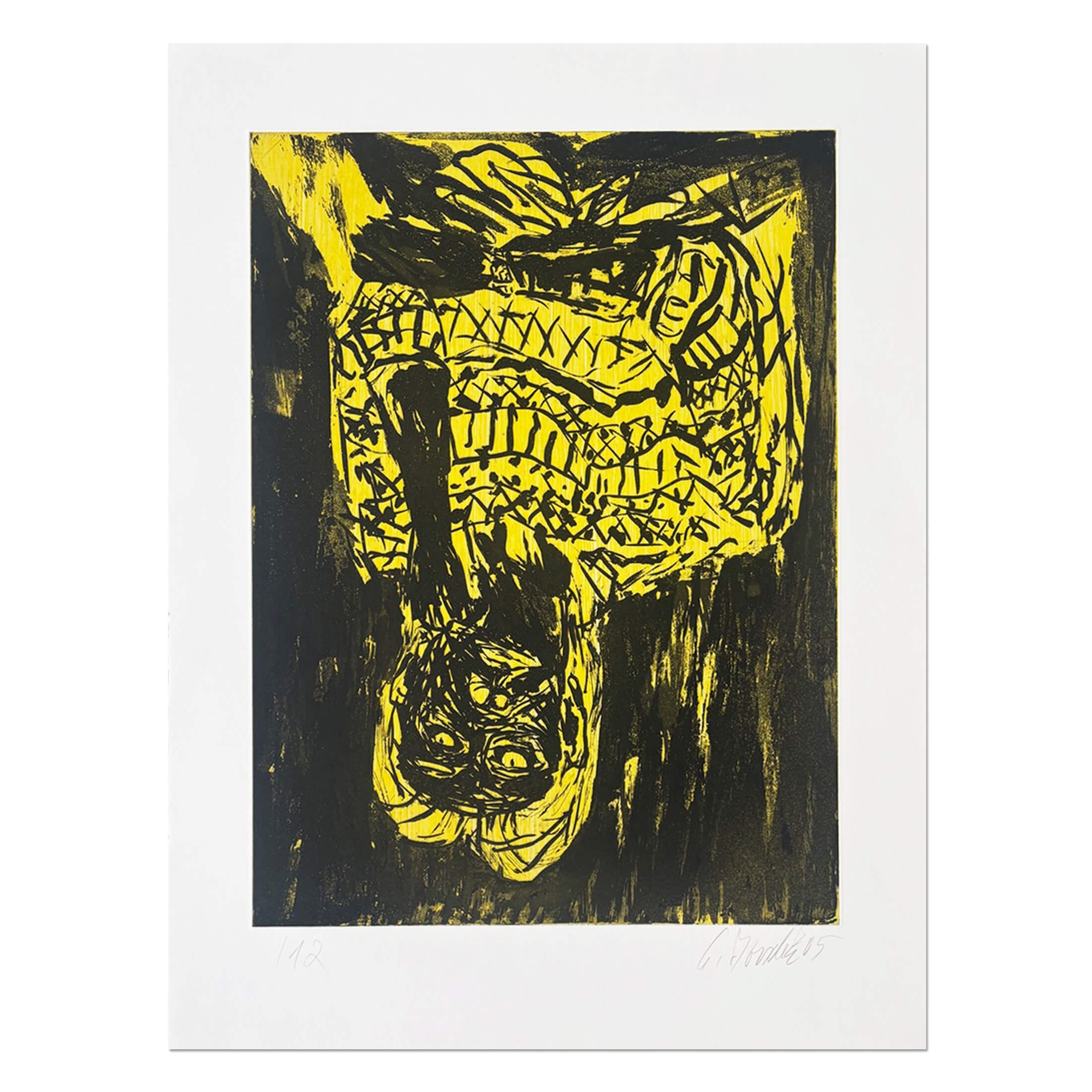
Printmaking ran alongside painting throughout his career — aquatint, drypoint, woodcut, linocut, often combined within a single sheet. From 2005 he extended this into the Remix series, reworking early compositions across paintings, watercolors, and editioned prints; the aquatints from that year, including this one, trace the same return.
Baselitz's work is held at MoMA, the Met, the Centre Pompidou, Tate, and the Guggenheim Bilbao. Represented for decades by Thaddaeus Ropac and Gagosian, he marked his eightieth birthday in 2018 with retrospectives at the Fondation Beyeler, the Pinakothek der Moderne, and the Hirshhorn Museum. He died in April 2026, days before his final exhibition, Eroi d'Oro, opened in Venice alongside the 61st Biennale.


