




Artist Insight
What My Bed Actually Did
The work that fixed Tracey Emin in the public imagination — My Bed, 1998 — was widely received as scandal. Dirty sheets, vodka bottles, used tissues, contraceptive packaging: the detritus of a genuine psychological collapse, installed in a gallery and nominated for the Turner Prize. The tabloids had a field day.
But the critical question was never whether this was art. It was what kind of art it was — and what it demanded of the viewer. My Bed operates as a self-portrait without a body, a space in which absence is more eloquent than presence. It translates psychic breakdown into a spatial proposition. Stand in front of it and you are not looking at an object. You are standing inside someone else's crisis, which is also, in some way, your own. That implication — the refusal to let the viewer remain a safely distanced spectator — is one of the defining qualities of Emin's practice.
Everyone I Have Ever Slept With 1963–1995, the tent appliquéd with 102 names stitched inside it, carried a similar charge. The title invited prurient reading. The work refused it. The names included childhood companions, family members, a twin who died at birth. It was a document of intimacy in its full, non-sexual complexity — and it was destroyed in the Momart warehouse fire of 2004, which gave it, retroactively, the quality of something irretrievable. A memory of a memory.

Confession as Structure
What Emin contributed to contemporary art was not simply self-revelation. Confession had existed in art long before her. What she developed was an understanding of confession as form — as a structural decision with visual and material consequences.
Her appliquéd blankets, monoprints, handwritten texts, and neon works do not merely tell stories. They stage the unstable process by which memory becomes language and language becomes image. The spelling errors are not oversights. The broken syntax is not naivety. They are part of the architecture. Vulnerability in Emin does not get resolved into clarity. It remains volatile — and that volatility is precisely what gives the work its charge.
This is where her practice enters into a genuinely critical dialogue with conceptual art, and particularly with the tradition of text-based art that runs from Joseph Kosuth through Jenny Holzer and Barbara Kruger. Earlier conceptual practices often used language to analyse systems, destabilise meaning, or operate at a deliberate remove from emotion. Emin's text does the opposite. It refuses distance. It moves toward the reader, intensifying rather than cooling the encounter. Her neons — I Promise to Love You, You Loved Me Like a Distant Star — are not propositions. They are direct address, suspended in light, speaking to no one and everyone at once.

Drawing and the Feminine Mark
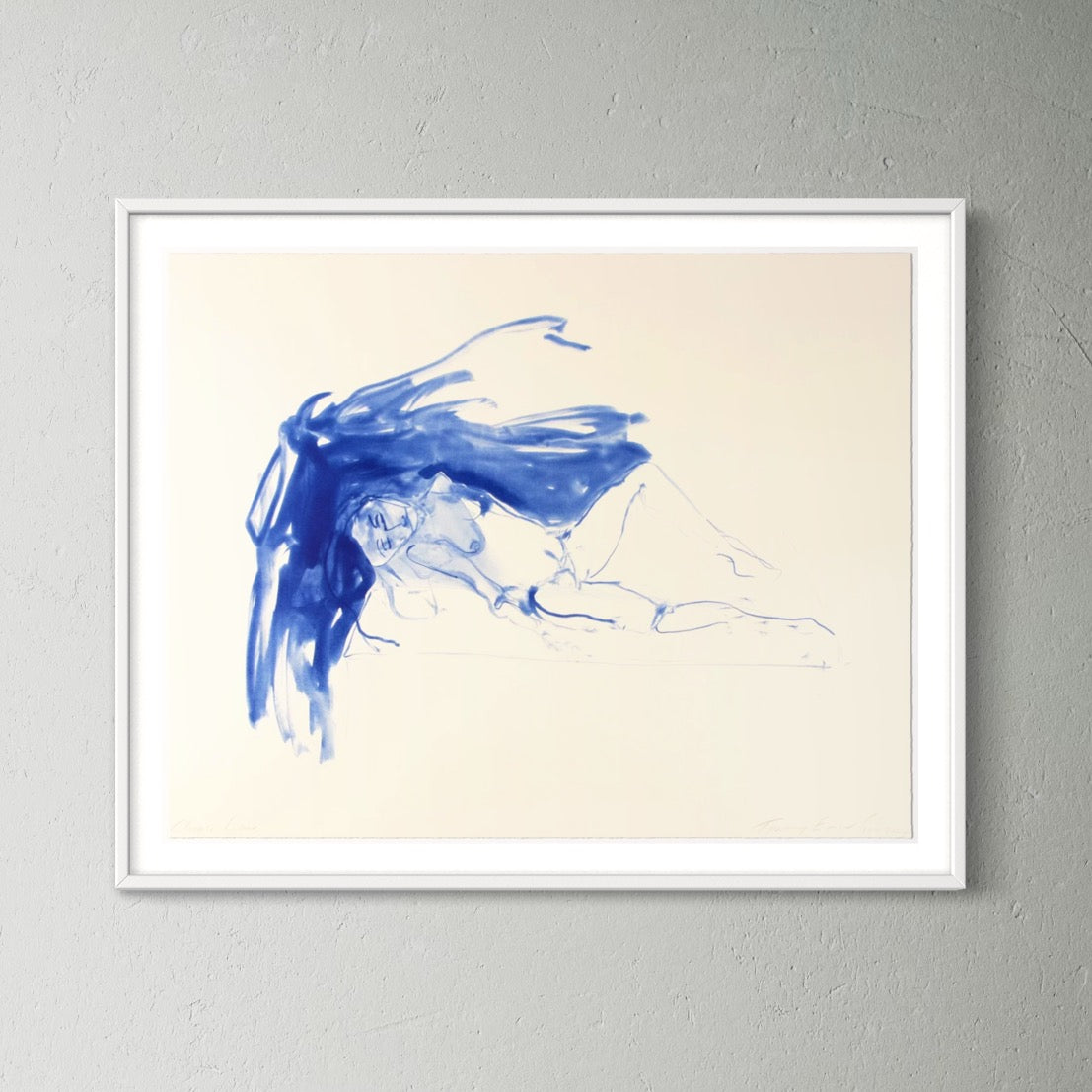
If neon brought her language into public space, drawing remained her most intimate and persistent form of thought. Even in large installations, drawing is the underlying discipline — the place where thinking becomes line.
Her figures are almost never complete. They tremble, open, or withdraw. What could be read as incompleteness is in fact a form of precision: the drawn body in Emin registers emotional states that finished form would neutralise. It appears as an event rather than a depiction, capturing the moment before experience settles into image.
This figural language connects her work to a longer history of feminist practice and post-1980 figuration — artists who returned to the body after its stability as a symbol had been thoroughly contested. But where much of that tradition engaged with the body as a cultural construct, Emin's figures carry the weight of something more contingent. They are specific. They are hers. The female body in her work is not symbolic. It is lived, marked by experience, and never resolved into ideal form.

From Installation to Paint
The later shift toward painting has been one of the most quietly significant developments of Emin's career. For an artist whose reputation was built on the accumulation of objects and environments, the move to canvas suggested a change of register — from debris to residue, from the evidence of experience to its concentrated afterimage.
The figures in these paintings are sparse, often barely there. But they carry an intensified emotional charge that the installations, for all their physical presence, rarely achieved. The gesture has replaced accumulation. The surface is not a stage. It is a site of urgency.
It was never a departure. It was a distillation. The underlying question — how can experience be made visible without losing its instability? — has not changed. Only the space in which it is asked.

Why She Matters
Tracey Emin's Turner Prize nomination in 1999, her representation of Britain at the Venice Biennale in 2007, her inclusion in major public collections worldwide: these are institutional facts, but they are also symptoms of a larger shift. Practices once dismissed as diaristic, excessive, or insufficiently detached from their maker now occupy the centre of art-historical discourse. Emin was decisive in that transition.
She did not achieve it by making the work more palatable. She achieved it by holding her ground — insisting that sexuality, grief, illness, humiliation, and desire were not peripheral to art's concerns but central to them, and that first-person material could carry conceptual weight without surrendering its rawness.
Her legacy is not stylistic. It is structural. She expanded the conditions under which personal experience could enter art as a legitimate form of intelligence — and she made it impossible, after her, to claim that emotional proximity and artistic rigour are in opposition.
Selected works by Tracey Emin are available in our collection.
My drawings are like my handwriting — they can't lie.
Selected questions on the artist’s practice, major artworks, and editions.
Tracey Emin: Key Questions


