




Collector Insights · Art History
What an Artwork Was Before It Was Numbered
To grasp how thoroughly the edition reorganized things, you have to remember what a print meant in the 18th and early 19th centuries. It meant a reproduction. The engraver translated a painting into line; the public bought the print as a stand-in for the canvas they would never see. The print's relationship to art was indexical — a footprint of an absent original. There was no question of the print itself being the artwork. Prints decorated parlors. Paintings filled museums.
The French etching revival
The first generation to challenge this hierarchy were the Barbizon-era etchers — Daubigny, Charles-Émile Jacque, Charles Meryon — who, around mid-century, started carrying portable copperplates outdoors and treating the etched line as a primary artistic act rather than a translation. By 1862 the publisher Alfred Cadart had organized this impulse into the Société des Aquafortistes (Paris, 1862–67), founding it as a deliberate stance against the rising mechanical medium of photography and framing the etched line as the most direct way to convey an artist's thought. He wanted to save the print from reproduction by insisting on its authorship.
But Cadart's project still left a problem. If the etching was original, why was it identical to all its siblings? What distinguished impression number three from impression number three hundred?

Whistler and the signed impression
Whistler, working in London in the same decades, supplied the answer through habit rather than theory. He trimmed his plates by hand. He inscribed each impression "imp" to indicate his personal supervision of the printing. He signed in pencil with his butterfly monogram, a mark he had developed in the 1860s as both signature and integrated compositional element. He treated the impression — not the plate — as the locus of authorship. The plate was the score; each impression was the performance.
Tellingly, Whistler charged twice as much for his hand-signed impressions as for the others from the same edition — even though there was no difference in the quality of the art. The market understood, instantly and correctly, that the artist's body had become the scarce resource.
This was the move that made art editions, in the modern sense, possible. Once authorship migrates from the matrix to the impression, the impression becomes a singular artwork that happens to have siblings. And once you have singular artworks with siblings, you can count them.
The Numbering, and What It Did
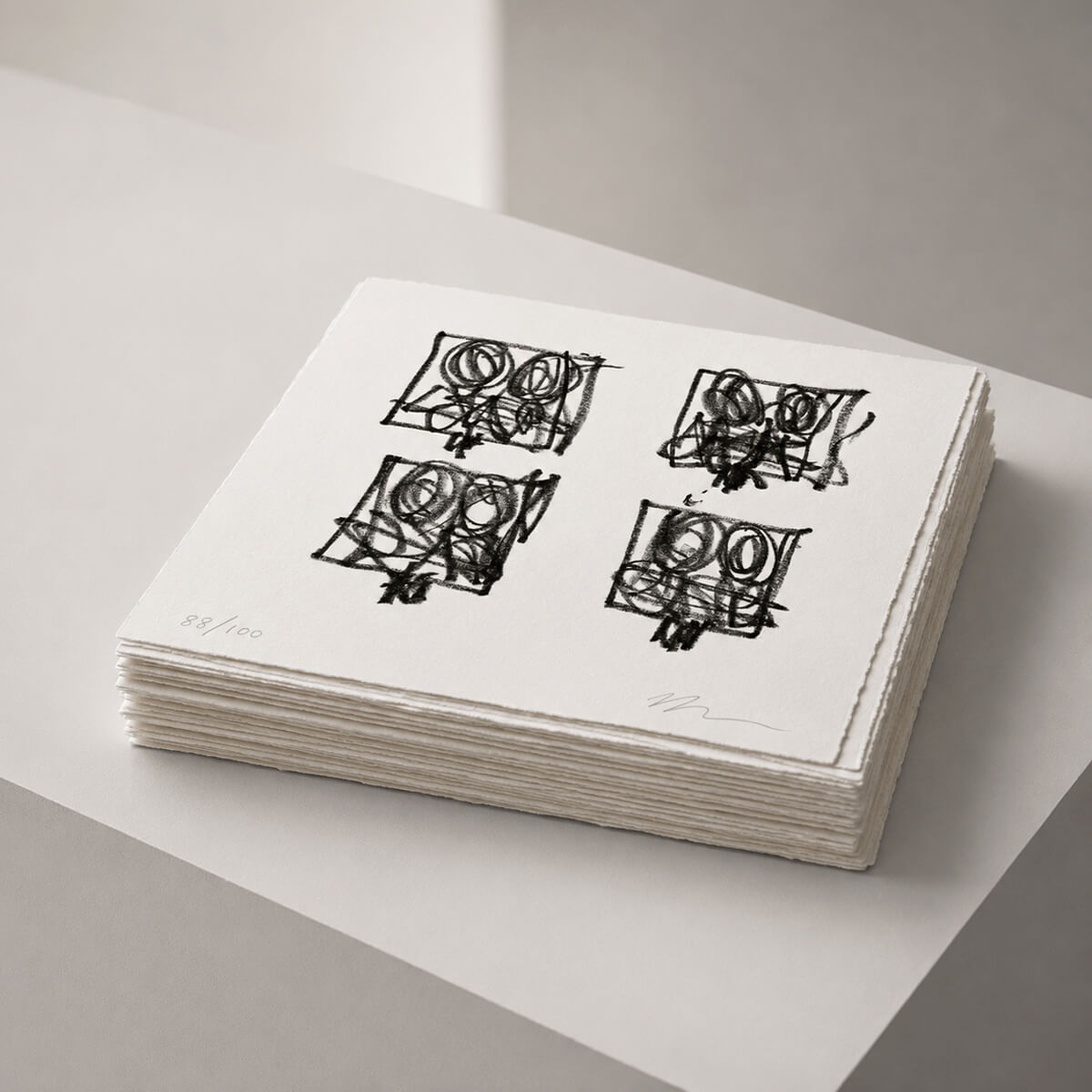
The convention of writing a fraction in pencil at the bottom of an impression — 17/75, 42/100 — looks, at first glance, like bookkeeping. It is bookkeeping. But it is also one of the most efficient pieces of conceptual engineering in the history of art. The fraction does at least four things at once.
It bounds the edition. Without 17/75, a print is potentially infinite; with it, the print belongs to a finite, declared set. The artist has voluntarily renounced further production from the matrix. Scarcity, which had been a natural property of unique paintings, becomes a willed property of multiples. The artist's restraint is the value.
It individuates the impression. 17/75 is not 18/75. The shared denominator binds the edition; the unique numerator distinguishes the artwork. An edition is a population of singular artworks, not a stack of copies — and the difference is not pedantic. It is the entire ontological premise on which prices, secondary markets, and museum acquisitions depend.
It authenticates through the artist's body. The pencil signature next to the number is irrelevant as draftsmanship — it is a notarization. The signature transposes the trust we extend to unique artworks (this hand made this thing) into a form that can survive mechanical reproduction. It is the trick that lets the edition cross Walter Benjamin's famous diagnosis from 1936, in which the reproduction loses its aura. The numbered, signed impression is a reproduction that smuggles its aura back in through the artist's name.
It creates a market that scales. Seventy-five collectors can own an artwork; only one can own a painting. The edition is the only artwork form whose economics permit a hundred simultaneous primary sales. This is not a footnote — it is the architectural principle of the entire modern print and photography market.
Vollard understood this precisely. His Bonnard album Quelques Aspects de la Vie de Paris (1895) was issued in one hundred numbered impressions, signed by the artist and produced at Auguste Clot's workshop. Around this small format he assembled an infrastructure: the master printer, the artist (the painter rather than a craftsman engraver), the publisher (himself, as gallerist and editor), and the certifying signature. This four-part structure — artist / printer / publisher / certificate — is essentially the form every serious edition has taken since.

From Device to Ideology: The Multiple in the 1960s
For sixty years after Vollard, the numbered edition lived inside the picture trade as a subsidiary. Then, in November 1959, something changed.
The invention of the multiple
Daniel Spoerri founded Edition MAT in Paris and the form mutated. Multiplication d'art transformable was the first programmatic series of editioned multiples to be broadly distributed, presenting works by Duchamp, Lichtenstein, Man Ray, Dieter Roth, Soto, and Tinguely.
Spoerri called these objects multiples — a term that had not previously existed in this sense — and the rhetoric around them turned immediately political. The multiple was the artwork that could enter daily life: small, affordable, owned, handled, manipulated.
What Spoerri made available was not just a new format but a new politics of the artwork. Conceptual art, Fluxus and Beuys's social sculpture were waiting in the wings, and they all needed a vehicle. They found it in the editioned multiple. Marcel Duchamp had quietly anticipated this in 1935 with the Boîte-en-valise, an editioned suitcase containing miniature reproductions of his entire oeuvre. By the mid-1960s George Maciunas was selling Fluxkits — Duchamp's idea reshaped as collective object — for as little as a few dollars by mail order. The edition was the only form that could carry such an idea, because the edition was the only artwork structure that had ever been designed, from its inception, to travel.
Beuys: the multiple as vessel
Joseph Beuys took the political logic of the multiple further than anyone before or since. From the early 1960s through to his death in 1986, he produced something on the order of six hundred editioned artworks: a wedge of felt, a sled with felt and fat, a Coca-Cola bottle filled with herbal tea, a lemon connected to a lightbulb, postcards, sugar packets, banknotes overwritten by hand. He used the multiple as the carrier wave of a political idea — a printed plastic carrier bag distributed at documenta 5 (Kassel, 1972) functioned as an information source for his Organization for Direct Democracy.
Beuys put the matter more pointedly than any artist before or since: "If you have all my multiples, then you have me completely." The sentence is precise. The multiples were him, dispersed across the world by the thousand, an artist's body distributed through the postal system. A painting hangs. A multiple circulates. The painting is where the viewer goes. The multiple comes to the viewer.

The American printmaking workshops
The American workshops of the same period made this reach a print-publishing scale. Tatyana Grosman founded Universal Limited Art Editions on Long Island in 1957 and drew Jasper Johns, Rauschenberg, Frankenthaler, Newman, Twombly and others into lithography; within seven years ninety-seven ULAE editions were chosen for the exhibition that inaugurated MoMA's new graphic galleries. Gemini G.E.L. opened in Los Angeles in 1966 and produced editions with Johns, Rauschenberg, Lichtenstein, Stella, Oldenburg, Serra and Hockney. Multiples, Inc., founded in New York in 1965, brought European artists like Beuys, Broodthaers, Palermo and Richter to American audiences.
The literature of the period describes the form, beautifully, as "a democracy of distribution" — and that phrase contains the central paradox of the edition. The numbered multiple is structurally aristocratic in its scarcity (only seventy-five exist) and structurally democratic in its dispersal (those seventy-five can be in seventy-five cities). The edition is the only artwork form that holds those two properties simultaneously, and that is the source of its power.
Photography: The Medium That Had to Invent Its Scarcity
The latest, and in some ways most revealing, chapter is the editioning of photography. From its first decades, photography occupied a strange position in the family of arts — present but undervalued, the unloved child. Baudelaire, in 1859, dismissed it acidly, demanding the medium "return to its true duty which is that of handmaiden of the arts and sciences." Cultural recognition arrived slowly and unevenly over the following century — but recognition was outpacing the market by half a century.
The invention of a photography market
The market itself only assembled, with some violence to photography's earlier self-understanding, between roughly 1969 and 1980. Photography is the most reproducible artwork form ever invented; a print from a copperplate degrades after a few hundred impressions, but a print from a negative is, in principle, infinitely reproducible without loss. The market that turned photography into "art" had to do something paradoxical: it had to scarcify the inherently abundant. It had to import the entire 19th-century apparatus of the edition — the signature, the number, the publisher's stamp, the limited run — into a medium where none of these had natural footing.
The infrastructure was built fast. Lee Witkin opened the Witkin Gallery in New York in 1969, the first commercially successful photography gallery in the city, and from 1971 began publishing limited edition portfolios. The dealer Harry Lunn, who in 1970 became the first to bring photographs to Art Basel, is widely credited with introducing the principle of editioning to the photography market — that is, the artificial limitation of supply as a deliberate marketing instrument. Sotheby's began offering photography at auction in 1971 and held its first regular New York photography sales from 1975.
Between Witkin's opening and the founding of AIPAD (the Association of International Photography Art Dealers, 1979), the limited edition print and portfolio became the standard vehicle for collecting and investing in photography. The "vintage print" — printed near the time of the negative, before strict edition discipline existed — became valuable precisely because it predated the editioning regime; the later editioned print became valuable precisely because it operated within it. Both depended on the same underlying logic: scarcity, when it does not occur naturally, must be willed and certified.

The Düsseldorf School and the edition as painting
The final move in photography's editioning history arrived in the late 1980s. As the Düsseldorf School photographers — Ruff, Struth, Gursky, Höfer, Hütte — began producing large-scale colour photographs at a scale and finish that placed them, conceptually and physically, in the tradition of history painting, the edition shrank to match the ambition. Presented in white-cube galleries in editions of six or ten, often face-mounted to acrylic and framed as singular objects, these works inhabited the wall like paintings and were collected as such.
The practice has since refined further, with editions of two, three or five now standard for major works by major artists — functionally indistinguishable from singular pieces in the secondary market, counted as part of the artist's main oeuvre, hung in museums alongside paintings, sold at evening sales rather than print sales. Photography had begun its journey as an unlimited medium, was scarcified into limited editions through the 1970s regime, and had now arrived at its logical endpoint: the edition as unique work.
The Edition in the 21st Century
The classical edition — signed, numbered, finite — is the spine of the market today, and the numbers now confirm what the market has long suspected: art editions are more widely collected than at any point in their history. According to Artprice's latest annual report, global auction turnover in prints and multiples reached approximately US $526 million in 2025 — a record high, up 11% year-on-year on a lot volume itself up 2%, from 198,100 lots sold worldwide. That represents 23% of all fine-art auction transactions globally.
|
$526M Global auction turnover, prints & multiples, 2025 — up 11% year-on-year |
198,100 Lots sold worldwide in 2025 — 23% of all fine-art auction transactions |
30 Lots crossed $1 million in 2025, led by a Warhol Marilyn set at $5.2M |
The long trend is even more telling: lot volumes have grown almost continuously since 2000 and accelerated sharply from 2020 onwards, continuing to rise even in years when overall market turnover softened. The category did not shed collectors during the 2023–2024 correction. It added them.
Collectors who once treated editions as a gateway to "real" collecting now treat them as a deliberate allocation in their own right, attracted by access to museum-grade artists, measurable resale data, and a liquidity profile that unique works rarely offer. Recent ArtTactic surveys place blue-chip artists at the top of collector confidence indices, and the market has delivered accordingly. Editions are no longer where the art market begins — they are one of the places where it decisively arrives.
Within this established market, several further forms have come into focus. Each has its own lineage and its own reason for existing. None of them replaces the conventional signed-and-numbered edition; they sit alongside it, addressing situations the classical model handles less well.
The timed edition
Until recently, an edition's scarcity was set in advance: 75, or 100, or 250. The artist had to guess at demand. The timed edition, established as a distinct format in the early 2020s, inverts the logic: the edition is offered for a fixed window — sometimes 48 hours, sometimes one to two weeks — and the final size is determined by how many collectors order during that period. When the window closes, the edition closes.
In a traditional edition, scarcity is fixed and demand is variable. In a timed edition, scarcity is adjusted to demand. For collectors, this lowers the entry price for editions by world-renowned artists, whose unique works on the secondary market have appreciated to levels that would otherwise foreclose access. It is a logical evolution of the classical edition for an internet-native moment.

The benefit edition
Editions sold to support a cause are not new — wartime artists' funds and gallery fundraisers have used the form for the better part of a century. What has changed is the scale and structural integration: the benefit edition is now one of the cultural economy's most reliable mechanisms for converting visibility into material support.
A museum running a major retrospective commissions a print from the artist; an arts foundation marking an anniversary publishes an edition with one of its associated artists; a social organisation partners with one or more artists to issue a benefit print at a fixed price for a fixed period. The artist contributes the artwork; the publisher absorbs production; a stated portion of the proceeds — often all of it — goes to the cause. This is the direct conceptual heir of Beuys's political multiple. What has changed is the cause. The structure is identical.
The unique edition
At the opposite end of the spectrum from the timed edition lies the edition's most curious form: the edition that is, in every practical sense, a unique work. Contemporary photography has arrived at this point via the Düsseldorf route described above, with editions of two to five now standard for major works. The same logic runs through the monotype — produced from a painted or inked surface that yields only one strong impression, a unique work in printmaking's clothing — and hand-coloured or hand-finished prints, where each impression is individually inflected after printing. What unites these forms is that the edition has been pushed to its outer conceptual boundary: the point at which "part of an edition" and "unique artwork" become almost the same statement.

The unsigned edition
Sitting in direct dialogue with the unique edition is a quieter, complementary practice. Some artists publish editions that are numbered, inscribed, sometimes stamped on the verso, but deliberately not hand-signed. The principle is older than it looks; Whistler charged double for his hand-signed impressions over otherwise identical unsigned ones from the same edition.
In contemporary practice, the unsigned edition is most often a tool of differentiation within a living artist's market — a smaller-format companion edition at a more accessible price, distinguished from the main work by signature, scale, and sometimes paper. The signature, in this architecture, becomes a tier marker rather than routine certification. Its absence does not diminish the work — but it tells the market which works the artist regards as central, and which as adjacent.
The NFT
The NFT, whatever else one thinks of it, belongs recognisably to this same lineage: an editioned digital object whose scarcity is willed rather than natural, and whose authenticity is certified by a mechanism designed for exactly that purpose. What Whistler's pencil butterfly did for the etched impression, and what Vollard's artist / printer / publisher / certificate structure did for the lithograph, the token contract now does for the digital file. The medium is new. The idea is Vollard's.
What the Edition Is, in the End
If you stand back from the whole arc — from Cadart's monthly etching subscriptions in 1862, to a Beuys felt suit in 1970, to a contemporary timed edition in 2026 — what becomes visible is that the numbered edition is not really a category of artwork. It is a technology of value and circulation that artists, publishers and dealers have built, refined, and politicized over a hundred and sixty years. It is the technology that lets an artwork be authored, owned, and dispersed at the same time. It is what makes ideas in art portable.
This is the part the access narrative misses. Art editions did not democratize art simply by lowering the price. They democratized art by changing what an artwork could do. A painting can speak to whoever stands before it; an edition can speak to a network. Beuys could not have run an organization for direct democracy with a single canvas. Maciunas could not have built Fluxus around unique objects. Vollard could not have made painters of Bonnard and Vuillard's generation famous if their work had remained on a single wall in a single apartment. The edition is the form that lets art participate in publics rather than households.
Every claim made for art editions — that they democratize access, that they make ideas circulate, that they let a single artwork live in seventy-five lives at once, that they can fund a museum or a refugee fund or an artist's career — is true. But none of these claims would be possible without the small, almost bureaucratic invention at the heart of it: a fraction, written in pencil, next to a signature. Or, increasingly, next to a stamp.
That mark — wherever it now lands — is the hinge on which the modern history of art editions, multiples and photographs turns. It is the moment at which an artwork stops being an object you stand in front of and becomes an object you can send into the world.
Explore the signed limited edition prints that continue this history today — or read our companion piece on Investing in Prints and Editions for the market case.
If you have all my multiples, then you have me completely.
Selected questions on this topic, its key figures, and its editions.
The History of Art Editions: Key Questions


