



Artist Insight
Memory as Method in Louise Bourgeois's Art
Louise Bourgeois frequently spoke of her childhood in a family that restored antique tapestries, a context in which damaged fabric was patiently rewoven. This early exposure to repair became a structural metaphor for her entire practice. The act of mending does not erase rupture; it makes it visible. Likewise, her sculptures do not resolve trauma. They hold it in suspension.
Her father's long affair with the family's governess — a betrayal that unfolded within the domestic space — reappears not as anecdote but as atmosphere. The house becomes a charged site of power and vulnerability. Domesticity becomes unstable terrain. Bourgeois understood early that intimacy and violence are not opposites; they coexist. Her art persistently stages that tension.
Autobiography in her artwork is therefore not confessional. It is architectural. Memory is treated as structure, something that can be entered, circled, and re-experienced.
The Body: Fragmented, Ambiguous, Unsettling
The human body is central to Louise Bourgeois's vocabulary, yet it rarely appears intact. Limbs detach, torsos swell, forms mutate between masculine and feminine attributes. Sexuality is neither celebratory nor illustrative; it is destabilizing. Artworks such as Fillette collapse eroticism and grotesque humor into a single gesture, challenging fixed readings of gender and desire.
This ambiguity is deliberate. Bourgeois understood the body as a site of conflict rather than identity. Her sculptures oscillate between softness and hardness, fragility and weight, latex and bronze, fabric and marble. These material shifts are not formal experiments; they embody psychological states. Marble can feel vulnerable; fabric can appear armored. Material becomes emotional syntax.
Across decades, she returned to similar bodily forms, not to refine them stylistically but to test them under new psychic conditions. Repetition in Bourgeois is not redundancy; it is persistence. Trauma does not vanish. It resurfaces, altered but intact.

Cells: Psychological Space as Sculpture
In the late 1980s and 1990s, Louise Bourgeois began constructing what she called Cells — enclosed installations composed of doors, cages, beds, mirrors, textiles, tools, fragments of bodies, personal objects. These artworks represent a decisive expansion of sculpture into immersive environment. They do not offer a single frontal viewpoint; they must be circled, glimpsed through apertures, encountered partially.
The Cells operate as architectures of containment. They stage exposure and protection simultaneously. The viewer stands outside yet peers in, implicated in a scene that feels private but is structurally public. Bourgeois once remarked that the Cells dealt with fear and pain. More precisely, they construct the conditions under which fear persists.
These installations profoundly shaped the trajectory of late twentieth-century installation art. Bourgeois demonstrated that sculpture could become psychological space — not merely an object occupying a room, but a room that occupies the psyche.
Maman and the Spider Sculptures
With Maman (1999), Louise Bourgeois translated her intimate language into monumental scale. The spider, towering yet delicate, holds within it a paradox: it is both maternal protector and silent predator. Bourgeois explicitly linked the spider to her mother, the patient weaver and restorer. Monumentality here is not heroic; it is protective. The massive structure shelters rather than dominates.
The spider's skeletal form underscores Bourgeois's ability to turn vulnerability into strength without dissolving ambiguity. It is fragile in structure yet commanding in presence. This duality — care and menace intertwined — defines much of her mature work.

Text, Fabric, and the Language of Memory
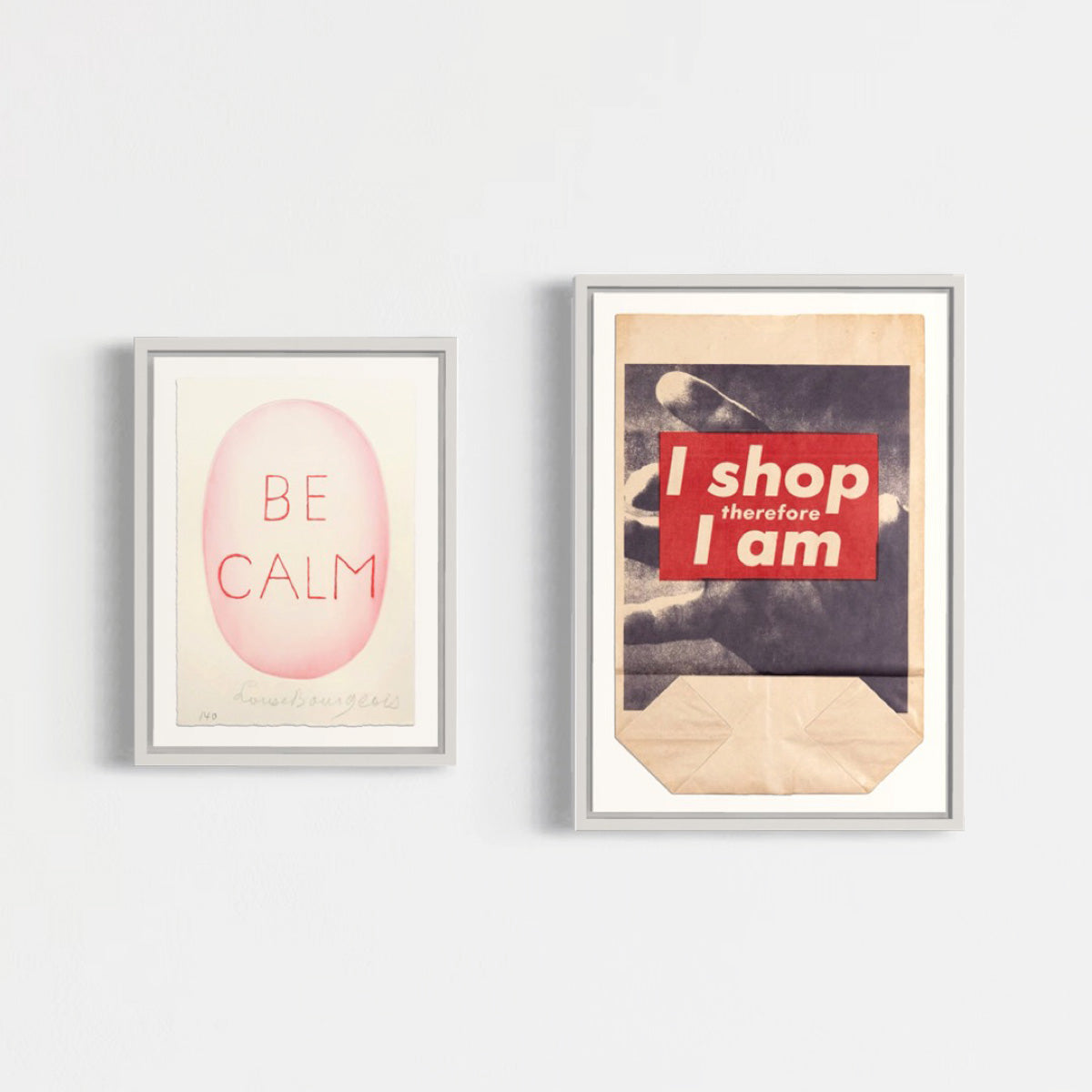
Although widely known for sculptures and installation art, Louise Bourgeois’s engagement with language constitutes a vital dimension of her practice. From the 1990s onward, she increasingly incorporated handwritten phrases, stitched words, and fragmentary sentences into works on paper and fabric, aligning her late production with developments in text-based art while retaining a distinctly personal register. These artworks do not function as captions or explanation; they operate as condensed emotional structures.
In drawings, gouaches, embroidered textiles, and reassembled garments, statements such as “I have been to hell and back” or “You better grow up” oscillate between confession, accusation, and self-address. Their apparent intimacy is disciplined by formal restraint; presented within the framework of the artwork, they become structured acts of containment rather than spontaneous disclosure.
Her turn to fabric intensifies this logic. By cutting and recomposing her own clothing and domestic textiles, Bourgeois transformed lived material into sculptural surface, allowing language to function as seam and suture. Memory becomes tactile, and the body appears through residue rather than representation. Writing, like sewing, becomes a method of binding rupture without erasing it.
Across scale, the monumental spider and the handwritten sentence operate within the same psychological system. Scale shifts, but the underlying tension remains: vulnerability held in balance with protection.
Drawings, Prints and Editions
Though widely known for sculpture, Louise Bourgeois maintained a rigorous drawing practice throughout her life. Works on paper were not preparatory sketches but laboratories of thought. In later decades, limited edition prints became a significant arena for revisiting motifs through serial variation. The sheer scale of her printed oeuvre underscores her commitment to repetition as method.
In these artworks, line becomes nervous system. Words occasionally enter the image, fragile and declarative at once. The intimacy of paper contrasts with the weight of bronze, yet the emotional intensity remains constant. Across media, Bourgeois treated making as an ongoing process of confrontation and repair.

Late Recognition and the Rise of Feminist Art
Although active since the 1940s, Louise Bourgeois achieved broad institutional recognition relatively late. Major retrospectives, including the landmark 1982 exhibition at the Museum of Modern Art in New York, repositioned her within the narrative of postwar art. This delayed canonization is not incidental. It reflects a broader shift in art-historical priorities — from formal purity to psychological complexity, from the formal autonomy associated with Postwar Abstraction to embodied experience, and toward the critical re-evaluation of gender and authorship advanced through Feminist Art.
Bourgeois did not align neatly with Surrealism, Abstract Expressionism, or Minimalism, though she intersected with each. Her singularity became fully legible only when art discourse expanded to accommodate interiority and gendered experience as structural concerns.
The Legacy of Louise Bourgeois's Art
Louise Bourgeois remains indispensable because she modeled a form of artistic practice in which vulnerability is not weakness but method. She anticipated contemporary concerns with trauma, domestic politics, bodily autonomy, and the instability of identity long before such frameworks became widespread.
Her work demonstrates that sculpture can operate as emotional architecture, that repetition can be analytical rather than decorative, and that biography can be transformed into structure without collapsing into confession. In a cultural moment increasingly attentive to memory, repair, and care, Bourgeois's practice feels not historical but urgently current.
She did not produce a style to be imitated. She produced a language of psychological construction that continues to inform how artists think about space, body, and memory.
Selected Louise Bourgeois artworks are available through our collection.
I have been to hell and back. And let me tell you, it was wonderful.
Selected questions on the artist’s practice, major artworks, and editions.
Louise Bourgeois: Key Questions


