


Artist Insight
Paris, Observation, and the Origins of Reduction
Ellsworth Kelly's mature language emerged during his years in Paris after the Second World War. Having served in the U.S. Army, he arrived in France in 1948 and immersed himself in European modernism, studying Monet's late panels, Romanesque architecture, and the disciplined clarity of early abstraction. Yet his most decisive influences were not theoretical; they were perceptual.
Kelly developed a method of looking grounded in direct observation. A shadow cast across a stairwell, the curve of a plant leaf, the contour of a window frame, the negative space between architectural elements — these fragments became starting points. He did not reproduce them as motifs. Instead, he extracted their shapes, isolating contours from context and translating them into autonomous forms. Through this process, representation dissolved into structure.
This act of distillation marked the beginning of Kelly's lifelong reduction. The world was not depicted; it was clarified. Abstraction, in his hands, became less an escape from reality than a means of intensifying perception.
The Turn to Objecthood
When Kelly returned to the United States in the mid-1950s, his approach stood in sharp contrast to the prevailing rhetoric of Abstract Expressionism. Where gesture and psychological projection dominated much of American painting, Kelly pursued restraint and structural clarity. The rectangular canvas, long assumed as neutral support, began to feel inadequate to the forms he was developing.
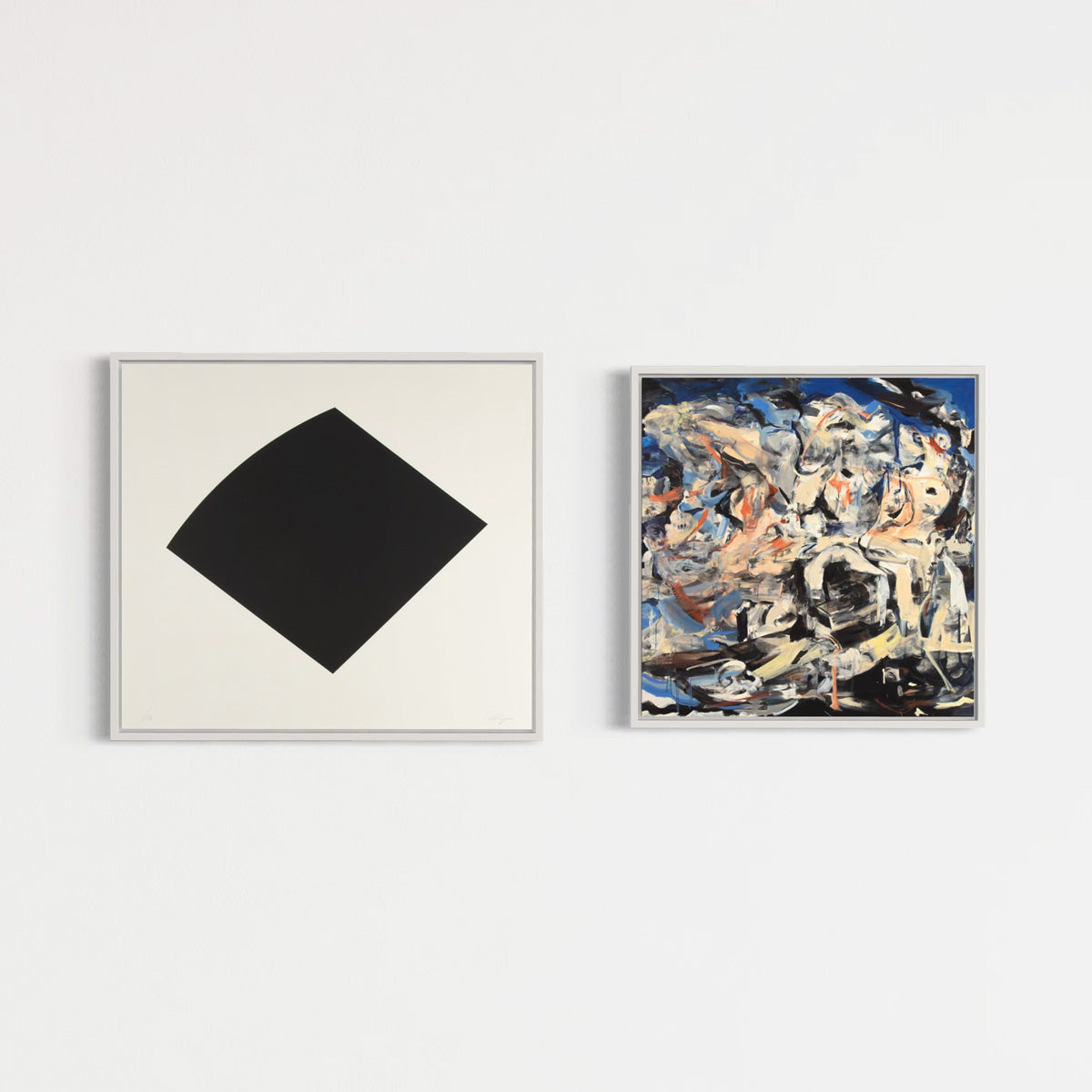
By the late 1950s and early 1960s, Kelly introduced shaped canvases whose contours followed the internal logic of the composition itself. The painting no longer conformed to the traditional rectangle; its outer edge became inseparable from its inner structure. This shift was decisive. The work ceased to function as a window and asserted itself as an object in real space.
In these shaped panels, color and support operate as a unified entity, aligning his work with the broader trajectory of Geometric Art while preserving its perceptual origins in observation. There is no illusionistic depth, no atmospheric recession. The painting occupies space directly, its physical presence reinforcing the autonomy of form. This redefinition of the canvas positioned Kelly at the intersection of painting and sculpture, expanding abstraction into a fully spatial practice.

Color as Structure
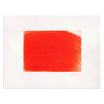
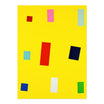
Color in Kelly's work is neither expressive nor symbolic. It does not describe mood, atmosphere, or narrative content. Instead, it operates as a structural element, defining shape and activating spatial relationships. His surfaces are composed of flat, unmodulated fields of color, applied with precision to eliminate visible gesture and personal trace.
A single hue can generate optical intensity; two adjacent tones can produce subtle tension or equilibrium. These interactions unfold through sustained looking. The viewer's embodied perception becomes central to the experience of the work. Rather than directing interpretation, Kelly's paintings stage perceptual encounters.
Through this disciplined isolation of color and form, Kelly demonstrated that reduction does not diminish complexity. On the contrary, it heightens awareness. His work transforms abstraction into a field of concentrated experience — one in which clarity produces depth rather than simplicity.
Drawing, Printmaking, and Media Interventions
Drawing was fundamental to Kelly's method. Through extensive line studies and contour sketches, he explored the translation of observed form into autonomous abstraction. This foundational work tracked the evolution of shape and how it might be translated into other media.
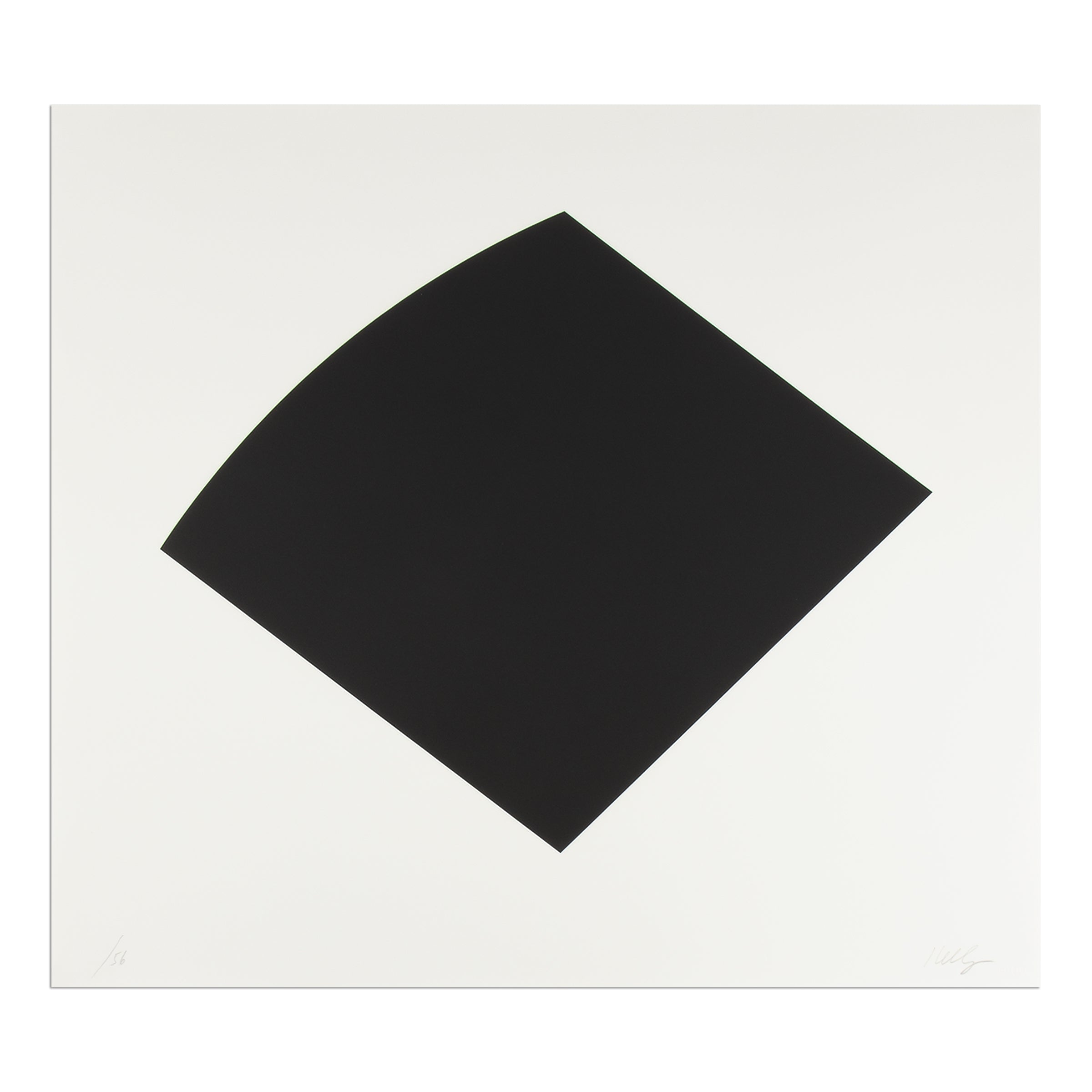
Printmaking became another vital domain. Kelly's lithographs, screenprints, and relief prints are not afterthoughts or secondary reproductions; they are parallel investigations into the interaction of form and color. Entire editions emphasize variations of line, contrast, and spatial relationships that mirror the structural concerns of his paintings, reinforcing the conceptual coherence of his visual language across formats.

Sculpture and Spatial Experience
Kelly extended his concerns with color and form into three dimensions. His freestanding works and wall-mounted reliefs emphasize volume, environmental interaction, and the play of light and shadow on surface. Unlike sculpture that foregrounds mass or narrative, Kelly's three-dimensional works maintain the formal austerity of his two-dimensional practice while engaging the viewer's movement and perception. In sculpture, as in painting, color and form operate inseparably within spatial context, activating the viewer's awareness of presence and perception simultaneously.
Institutional Presence and Major Exhibitions
Kelly's career has been marked by sustained institutional recognition. His inclusion in the Museum of Modern Art's Sixteen Americans exhibition in 1959 — a defining survey of postwar abstraction — signaled early acknowledgment of his distinct position within American art. Over subsequent decades, his work appeared in major international exhibitions that helped shape the evolving narrative of modern and contemporary abstraction.
The 1996–97 retrospective Ellsworth Kelly: A Retrospective, organized by the Solomon R. Guggenheim Museum and traveling to the Museum of Contemporary Art, Los Angeles; Tate Gallery, London; and Haus der Kunst, Munich, provided the most comprehensive survey of his practice to date and affirmed his central place in twentieth-century abstraction.
More recently, centennial exhibitions such as Ellsworth Kelly at 100 — presented at Glenstone and traveling to Fondation Louis Vuitton and M7 in Doha — have reaffirmed the continuing relevance of his work. His paintings and sculptures are held in leading public collections worldwide, including the Museum of Modern Art and Whitney Museum of American Art in New York, Tate Modern in London, and the Centre Pompidou in Paris.

Position within Postwar Abstraction
Kelly occupies a pivotal position within the evolution of Postwar Abstraction. In contrast to Abstract Expressionism's emphasis on gesture and subjective projection, he pursued a practice defined by clarity, restraint, and objecthood. His emphasis on shape and perceptual encounter shares affinities with Minimalism, yet his work preserves a distinct painterly sensibility grounded in direct observation and refinement of form. As such, Kelly acts both as a continuation of and counterpoint to European modernist abstraction and American postwar developments, bridging historical dialogues about surface, space, and perception.
Legacy
Ellsworth Kelly's legacy lies in his sustained commitment to visual clarity, material integrity, and perceptual rigor. Through reduction, he expanded abstraction's possibilities without diminishing its depth, demonstrating that reduction itself can generate complexity. His influence extends across generations of artists concerned with geometry, color, and the autonomy of form — affirming his role as one of the defining architects of modern visual language.
Selected works by Ellsworth Kelly are available through our collection.
I don’t want to paint pictures that illustrate ideas. I want to create something that is itself an object.
Selected questions on the artist’s practice, major artworks, and editions.
Ellsworth Kelly: Key Questions


