Jonas Wood

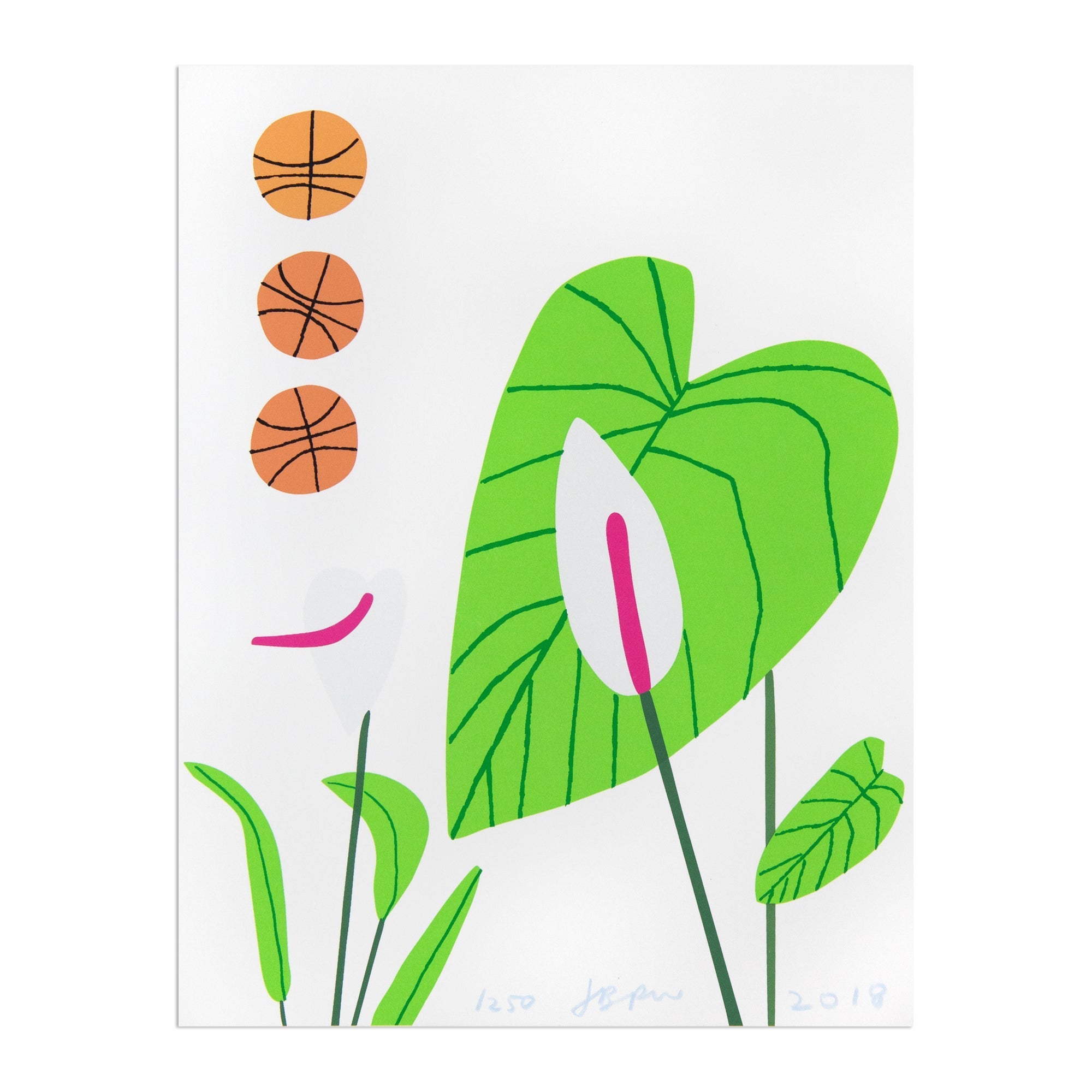
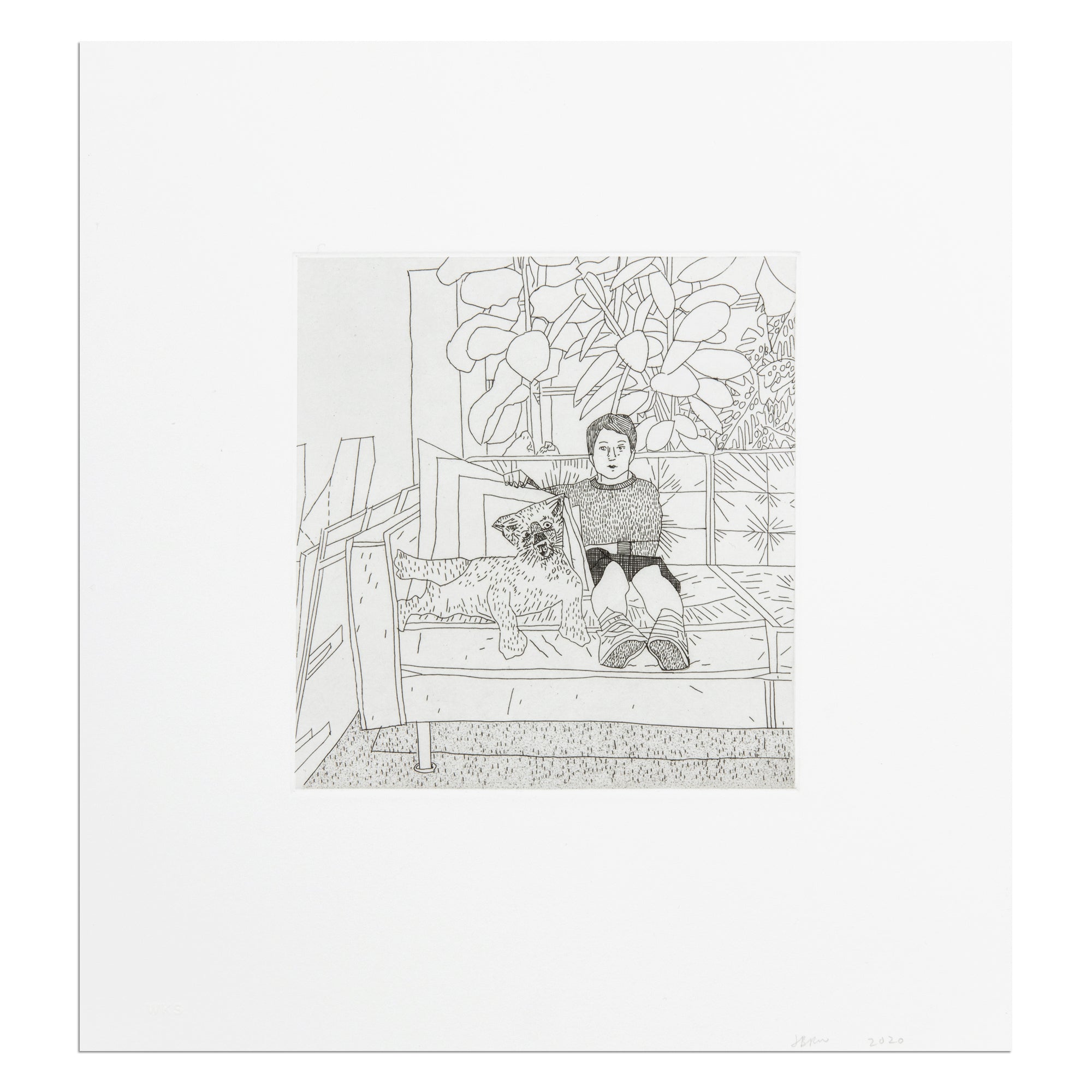
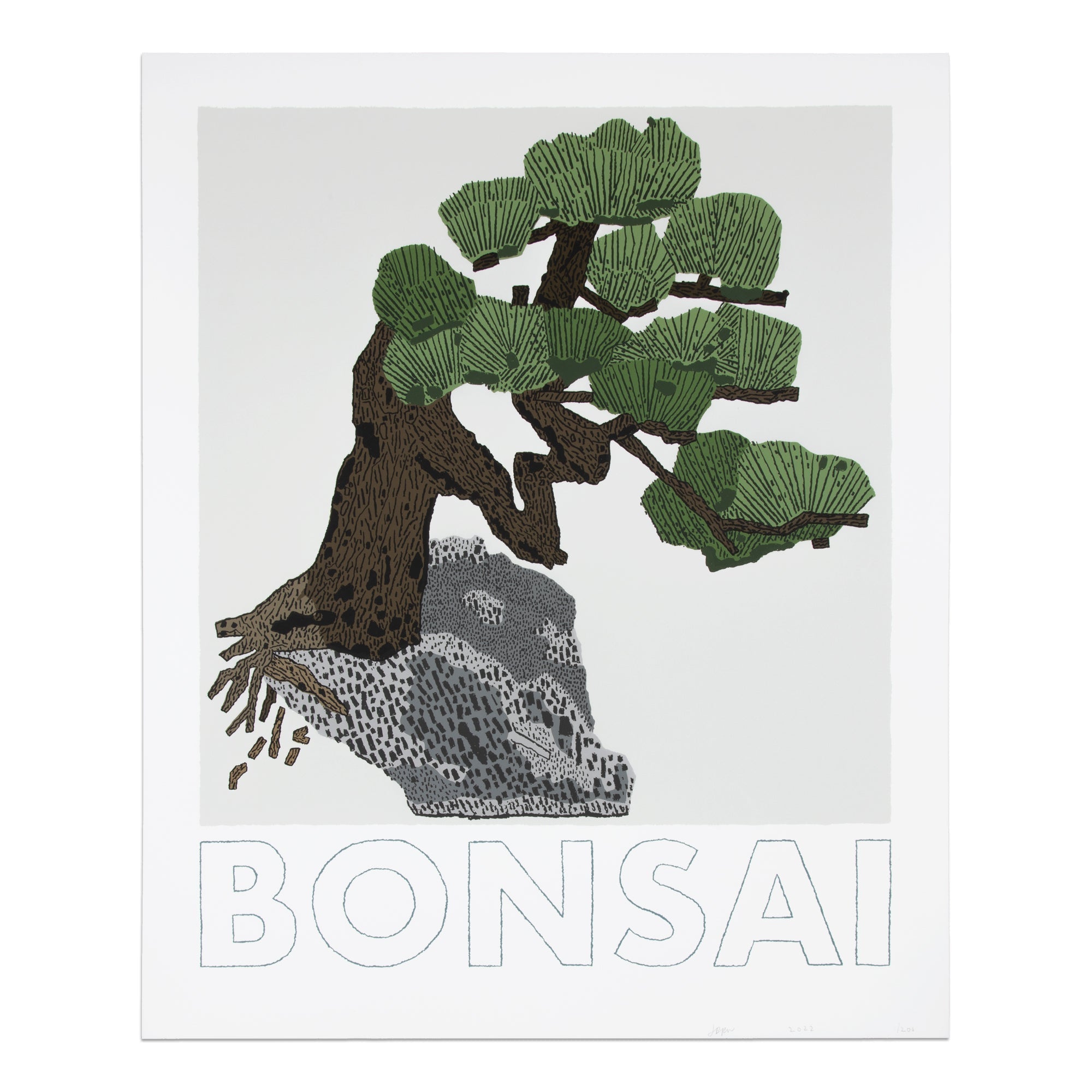
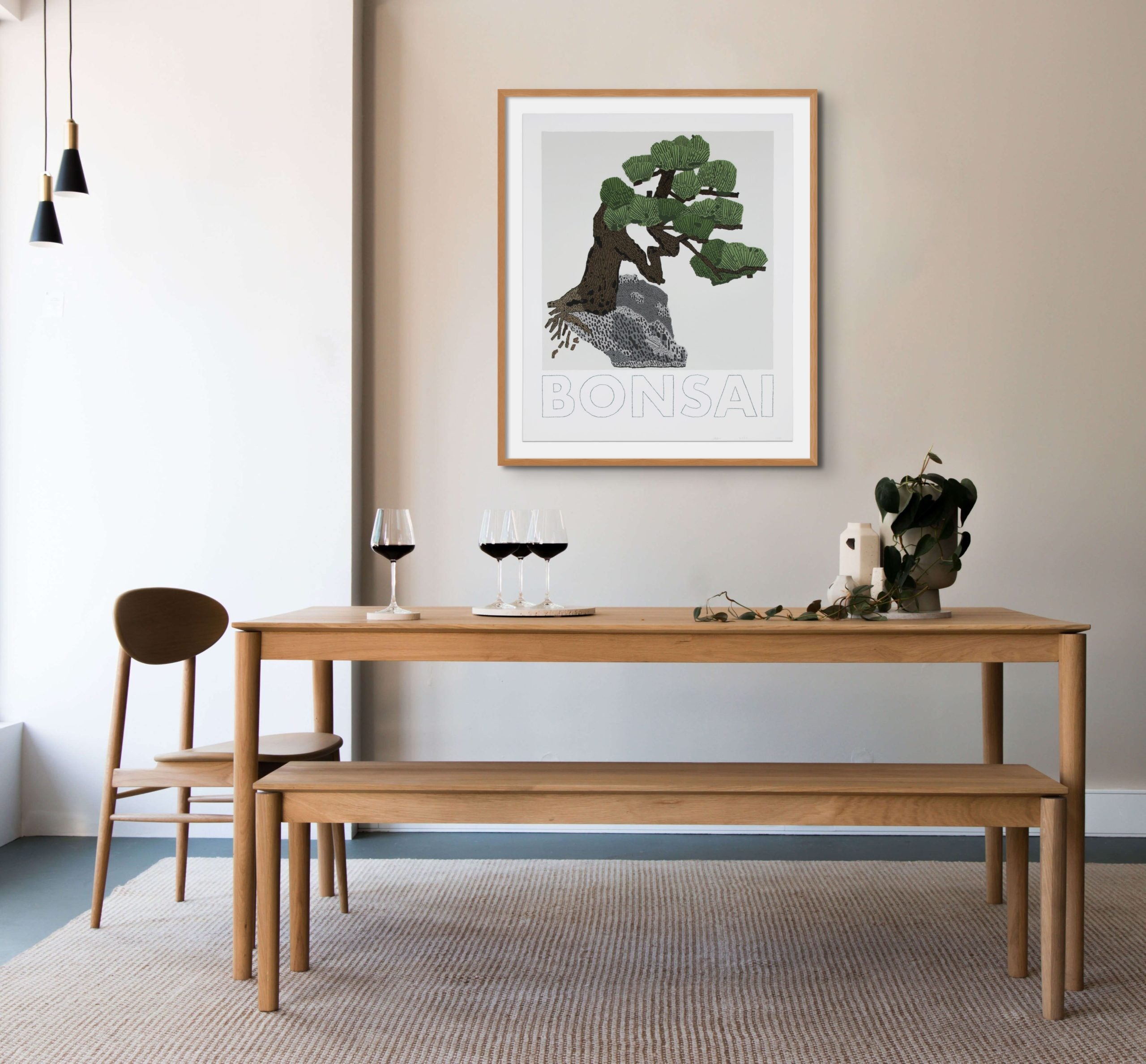
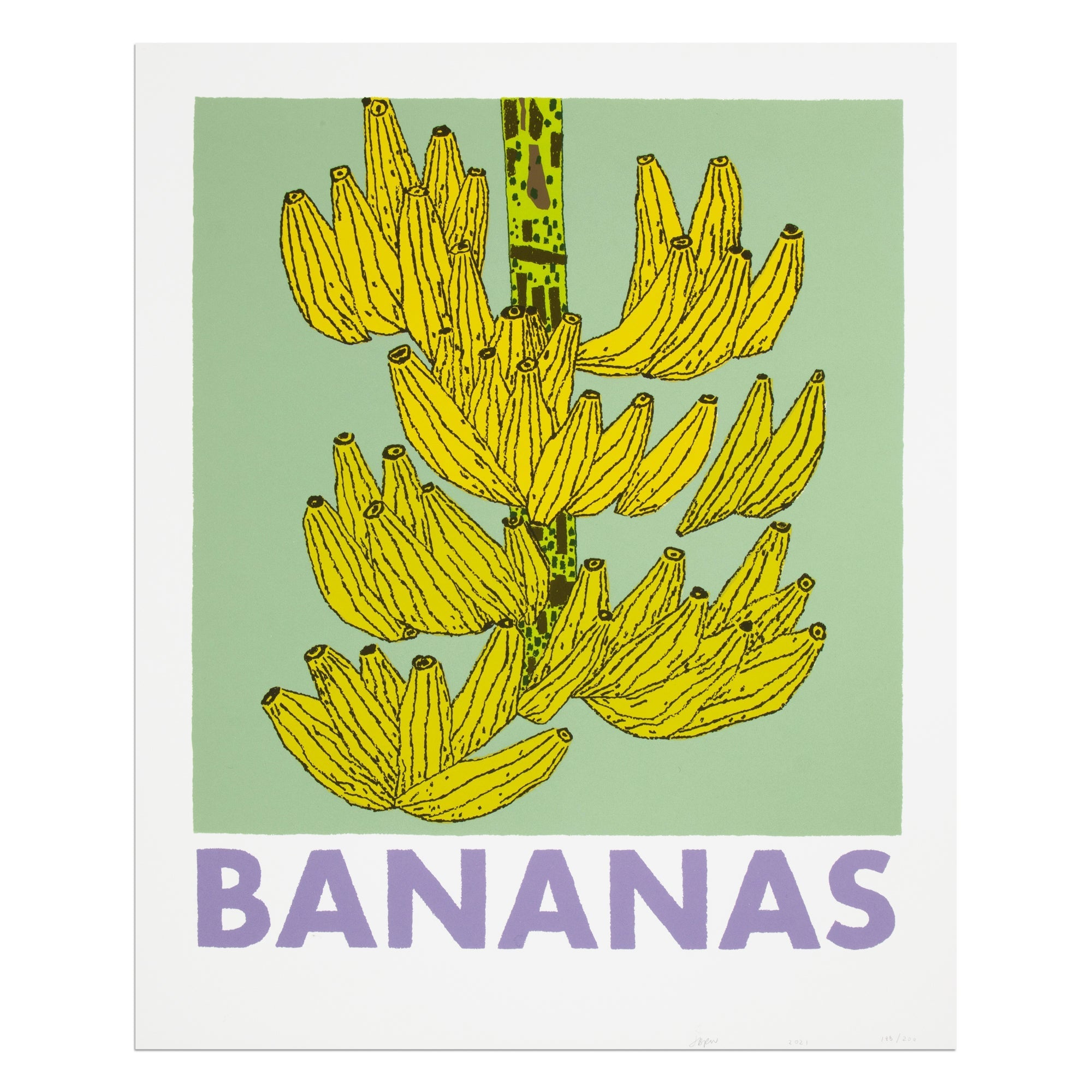
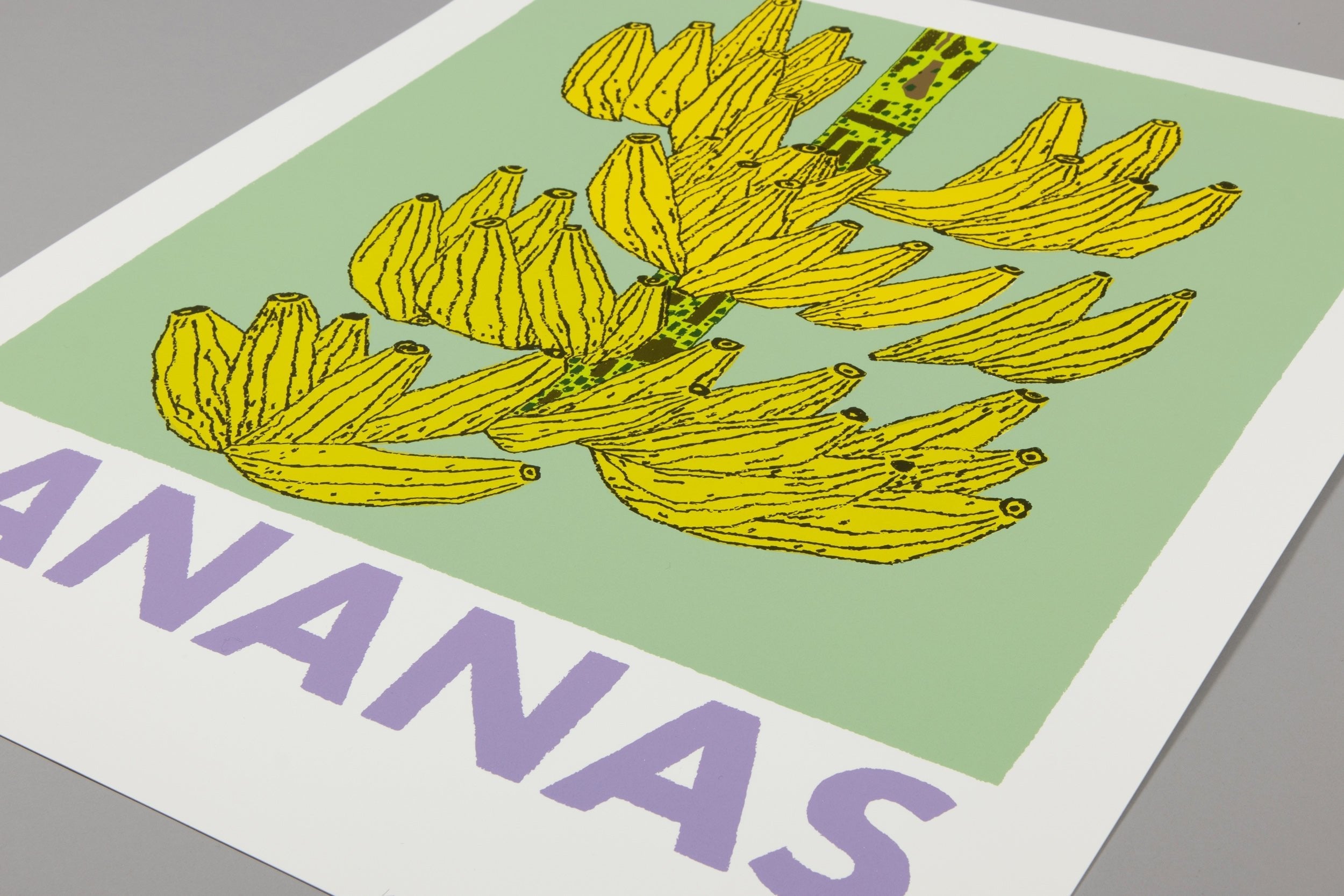
Jonas Wood builds paintings the way a collage artist builds an image — cutting up photographs of his own life, rearranging the fragments, then translating the result into flattened, densely patterned compositions. Potted plants, basketball cards, domestic interiors, portraits of friends and family: familiar subjects rendered through a distinctly analytical eye for pattern, geometry, and colour. These prints and editions carry that same collage logic directly into print, often as its most literal and successful form.
Browse signed Jonas Wood prints and editions now.
Available Prints & Editions
7 products

Jonas Wood (born 1977 in Boston) studied psychology as an undergraduate before completing an MFA in painting at the University of Washington in 2002. He assisted the painter Laura Owens early in his career — a formative apprenticeship in the practical realities of a studio practice — before his 2006 solo debut in Los Angeles established him as an artist to watch. Wood is based in Los Angeles, where he shares a studio with his wife, the ceramicist Shio Kusaka; the relationship between their practices runs in both directions — Kusaka's vessels appear constantly in Wood's still lifes, while motifs from his paintings resurface on the surfaces of her pots.
Jonas Wood's method begins away from the canvas. He works from photographs — his own snapshots, family pictures, images sent by others — cutting and layering them into collages that fix composition before a brushstroke is applied. What results is not simple flatness but a deliberately built ornamental density: interlocking planes of pattern, texture, and colour that carry as much psychological weight as any single depicted object. The comparison to Gustav Klimt is not far-fetched — both artists treat pattern as content rather than decoration, letting ornament and repetition do work that figuration alone could not.
That tension between figuration and abstraction is nowhere clearer than in his tennis court paintings, begun in 2010 and developed across several major series since. Composed from television broadcasts rather than the game itself, they strip away players, balls, and spectators, leaving only the foreshortened geometry of the court — a field of flat colour indebted to Josef Albers's Homage to the Square. What began as figurative subject matter becomes, through Wood's systematic removal of narrative detail, a genuine exercise in colour-field abstraction. It is the clearest demonstration in his practice of a method he learned early from David Hockney: that flatness is not a limitation but a way of seeing more clearly.
Sport runs through his broader work as well. A committed collector of vintage memorabilia, Wood began painting trading cards in 2005, describing them as "ready-made portraits" — a fittingly self-aware term for an artist whose own signed prints have, in turn, become sought-after collectibles.

Two Tables with Floral Pattern (2013) became Jonas Wood's auction record when it sold for $6.5 million at Christie's New York in 2021 — a still life whose interlocking, wallpaper-dense patterning distils his central technique: figuration built almost entirely from flattened, decorative structure, close in spirit to Klimt's own treatment of ornament as psychological information.
His tennis court paintings, including works such as French Open with Wood Grain (2025), represent the fullest expression of his figuration-into-abstraction method. Sourced from televised matches rather than lived experience, and stripped of every player and ball, these canvases reduce the game to pure geometric colour field — proof that Wood's flattened style can carry a subject to the point of near-total abstraction while never quite letting go of its representational origin.
Ovitz's Library (2013), now in the permanent collection of the Guggenheim Museum, marked a genuine turning point in Wood's process. Commissioned by the collector and MoMA trustee Michael Ovitz to depict his own art-filled Beverly Hills home — its shelves and staircase hung with works by Alexander Calder, Martin Kippenberger, and Mark Grotjahn — the painting was the first Wood completed without a preparatory drawing, a working habit he had followed rigidly until then. "That was a big breakthrough for me," he later said. "I had OCD about how it had to be that way, but I needed to break from that."
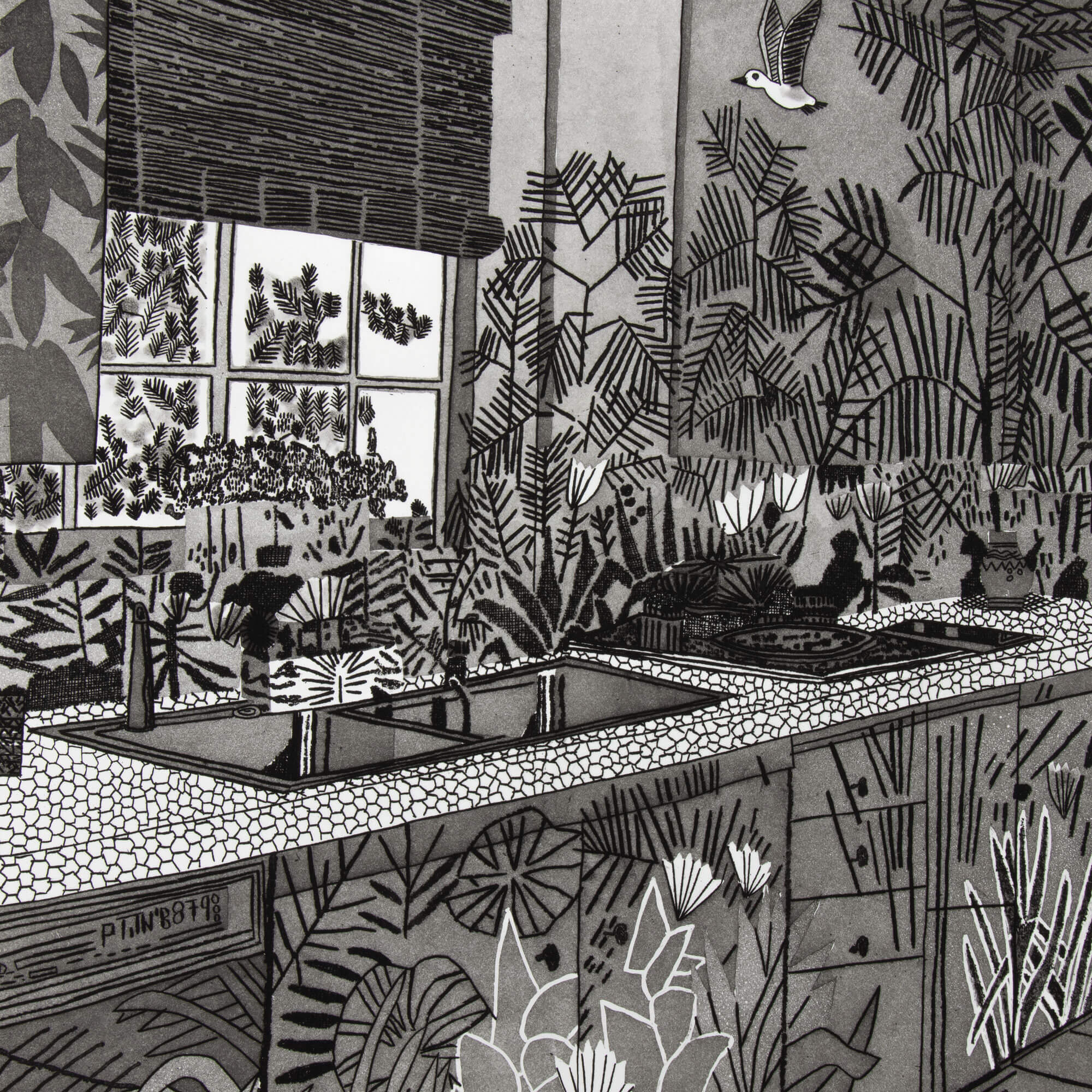
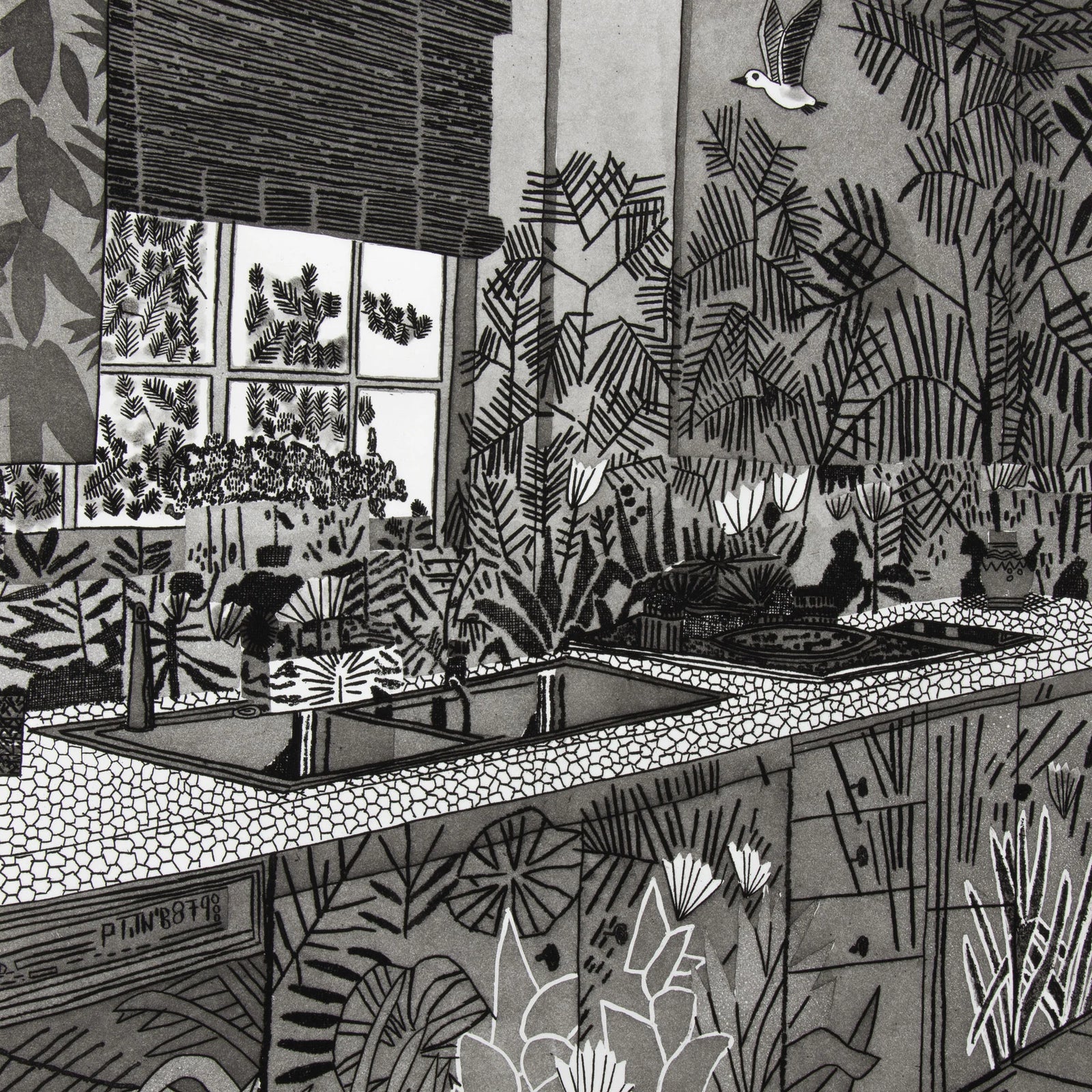
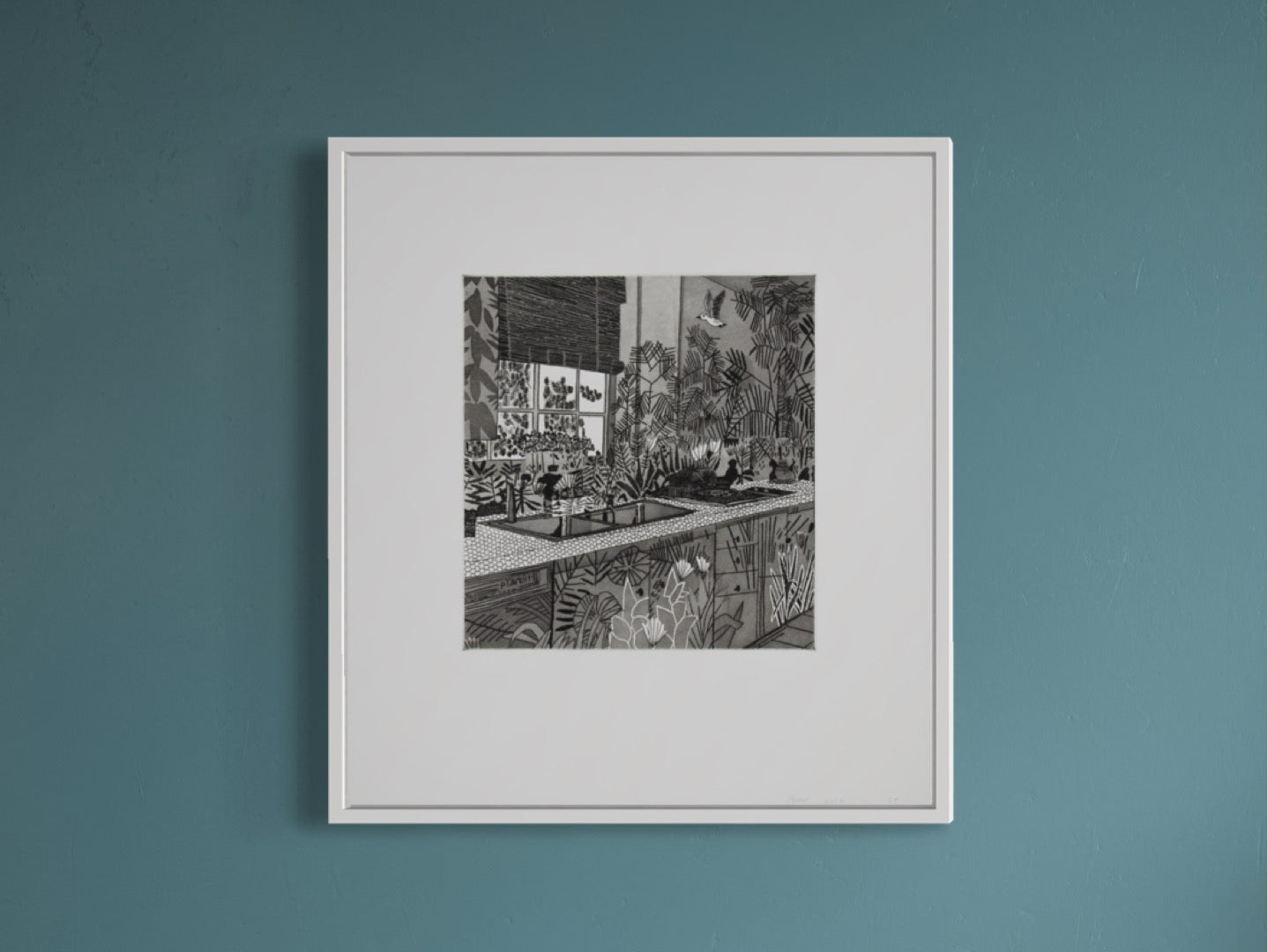
Jungle Kitchen (2017), a densely patterned interior painting, marked a turning point in his printmaking as well as his painting: the etching made from it, developed with printmaker Jacob Samuel, condensed everything Wood had learned about mark-making across several years of studio collaboration into a single, technically ambitious work.

Jonas Wood is among the most serious painter-printmakers working today — a modern peintre-graveur in the tradition of artists who treat the print studio as a second, equally rigorous practice rather than a commercial sideline. He has said plainly, "I'm pretty heavy into printmaking," and the numbers bear it out: prints account for the majority of his work sold at auction, an unusually high figure for a painter of his market standing.
His education in the medium came directly from Jacob Samuel, the Los Angeles printmaker who had worked as Sam Francis's personal printer since 1981. Beginning in 2013, Wood spent a year and a half learning hard-ground and soft-ground etching, spit bite, aquatint, and chine-collé — the delicate technique of bonding coloured Japanese paper to a print's surface — documenting his own progress across the 8 Etchings (2014) series. Wood has cited Ed Ruscha as a direct inspiration for treating printmaking, drawing, and painting as a single, mutually informing practice — a connection made literal when Wood rented his primary studio directly from Ruscha in 2007, working there for a decade in the space where Ovitz's Library and the basketball studies that became Bball Studio (2019) were made. He has spoken of wanting to do for younger printmakers what Ruscha's example did for him.
That ambition led Jonas Wood to found WKS Editions — Wood Kusaka Studios — his own dedicated print house, built with Samuel and staffed by specialist printers including Kevin Giffen, Daniel Wlazlak, and Sam Gessow. It is an unusual step for a painter of his generation: rather than working with an outside publisher on their schedule, Wood set up an atelier operating entirely on his own terms, producing the Matisse Pot screenprints (2018) — thirty-colour prints made in homage to Henri Matisse and Kusaka's ceramics — and the 8 Pots (2017) etchings, developed further under his own roof.
For collectors, his limited edition prints are never secondary reproductions but distinct, fully realised works that directly feed back into his paintings. Works are held in the permanent collections of MoMA, the Whitney Museum, and the Museum of Contemporary Art, Chicago.
Jonas Wood (born 1977 in Boston) studied psychology as an undergraduate before completing an MFA in painting at the University of Washington in 2002. He assisted the painter Laura Owens early in his career — a formative apprenticeship in the practical realities of a studio practice — before his 2006 solo debut in Los Angeles established him as an artist to watch. Wood is based in Los Angeles, where he shares a studio with his wife, the ceramicist Shio Kusaka; the relationship between their practices runs in both directions — Kusaka's vessels appear constantly in Wood's still lifes, while motifs from his paintings resurface on the surfaces of her pots.
Jonas Wood's method begins away from the canvas. He works from photographs — his own snapshots, family pictures, images sent by others — cutting and layering them into collages that fix composition before a brushstroke is applied. What results is not simple flatness but a deliberately built ornamental density: interlocking planes of pattern, texture, and colour that carry as much psychological weight as any single depicted object. The comparison to Gustav Klimt is not far-fetched — both artists treat pattern as content rather than decoration, letting ornament and repetition do work that figuration alone could not.
That tension between figuration and abstraction is nowhere clearer than in his tennis court paintings, begun in 2010 and developed across several major series since. Composed from television broadcasts rather than the game itself, they strip away players, balls, and spectators, leaving only the foreshortened geometry of the court — a field of flat colour indebted to Josef Albers's Homage to the Square. What began as figurative subject matter becomes, through Wood's systematic removal of narrative detail, a genuine exercise in colour-field abstraction. It is the clearest demonstration in his practice of a method he learned early from David Hockney: that flatness is not a limitation but a way of seeing more clearly.
Sport runs through his broader work as well. A committed collector of vintage memorabilia, Wood began painting trading cards in 2005, describing them as "ready-made portraits" — a fittingly self-aware term for an artist whose own signed prints have, in turn, become sought-after collectibles.
Two Tables with Floral Pattern (2013) became Jonas Wood's auction record when it sold for $6.5 million at Christie's New York in 2021 — a still life whose interlocking, wallpaper-dense patterning distils his central technique: figuration built almost entirely from flattened, decorative structure, close in spirit to Klimt's own treatment of ornament as psychological information.
His tennis court paintings, including works such as French Open with Wood Grain (2025), represent the fullest expression of his figuration-into-abstraction method. Sourced from televised matches rather than lived experience, and stripped of every player and ball, these canvases reduce the game to pure geometric colour field — proof that Wood's flattened style can carry a subject to the point of near-total abstraction while never quite letting go of its representational origin.
Ovitz's Library (2013), now in the permanent collection of the Guggenheim Museum, marked a genuine turning point in Wood's process. Commissioned by the collector and MoMA trustee Michael Ovitz to depict his own art-filled Beverly Hills home — its shelves and staircase hung with works by Alexander Calder, Martin Kippenberger, and Mark Grotjahn — the painting was the first Wood completed without a preparatory drawing, a working habit he had followed rigidly until then. "That was a big breakthrough for me," he later said. "I had OCD about how it had to be that way, but I needed to break from that."
Jungle Kitchen (2017), a densely patterned interior painting, marked a turning point in his printmaking as well as his painting: the etching made from it, developed with printmaker Jacob Samuel, condensed everything Wood had learned about mark-making across several years of studio collaboration into a single, technically ambitious work.
Jonas Wood is among the most serious painter-printmakers working today — a modern peintre-graveur in the tradition of artists who treat the print studio as a second, equally rigorous practice rather than a commercial sideline. He has said plainly, "I'm pretty heavy into printmaking," and the numbers bear it out: prints account for the majority of his work sold at auction, an unusually high figure for a painter of his market standing.
His education in the medium came directly from Jacob Samuel, the Los Angeles printmaker who had worked as Sam Francis's personal printer since 1981. Beginning in 2013, Wood spent a year and a half learning hard-ground and soft-ground etching, spit bite, aquatint, and chine-collé — the delicate technique of bonding coloured Japanese paper to a print's surface — documenting his own progress across the 8 Etchings (2014) series. Wood has cited Ed Ruscha as a direct inspiration for treating printmaking, drawing, and painting as a single, mutually informing practice — a connection made literal when Wood rented his primary studio directly from Ruscha in 2007, working there for a decade in the space where Ovitz's Library and the basketball studies that became Bball Studio (2019) were made. He has spoken of wanting to do for younger printmakers what Ruscha's example did for him.
That ambition led Jonas Wood to found WKS Editions — Wood Kusaka Studios — his own dedicated print house, built with Samuel and staffed by specialist printers including Kevin Giffen, Daniel Wlazlak, and Sam Gessow. It is an unusual step for a painter of his generation: rather than working with an outside publisher on their schedule, Wood set up an atelier operating entirely on his own terms, producing the Matisse Pot screenprints (2018) — thirty-colour prints made in homage to Henri Matisse and Kusaka's ceramics — and the 8 Pots (2017) etchings, developed further under his own roof.
For collectors, his limited edition prints are never secondary reproductions but distinct, fully realised works that directly feed back into his paintings. Works are held in the permanent collections of MoMA, the Whitney Museum, and the Museum of Contemporary Art, Chicago.


Jonas Wood: Key Questions
Collecting Jonas Wood?
Looking for a specific artwork or have a question about an edition? We're happy to advise on availability, pricing, condition, and provenance — and to source artworks beyond our current selection.
What is Jonas Wood known for?
Jonas Wood is known for vibrant, flattened paintings of botanical still lifes, patterned domestic interiors, portraits, and sports imagery, built from a distinctive collage-based process. Based in Los Angeles, he is regarded as one of the most recognisable painters of his generation, working at the intersection of figurative subject matter and near-total abstraction.
How does Jonas Wood create his paintings?
Wood begins almost every composition away from the canvas, working from photographs — his own, appropriated, or sent by others — which he cuts and layers into collages before painting. This process determines composition and flattened perspective in advance, producing the pattern-driven density that defines his mature style.
Why does Jonas Wood paint tennis courts?
Wood paints tennis courts sourced from television broadcasts, deliberately removing players, balls, and spectators to leave only the court's foreshortened geometry and colour. The result pushes an ostensibly figurative subject toward pure colour-field abstraction, echoing Josef Albers's serial investigations of colour within a fixed geometric structure.
Why do ceramic pots appear so often in Jonas Wood's work?
The pots in Wood's paintings and prints reference the ceramics of his wife, Shio Kusaka, whose studio he shares. The relationship runs both ways: her vessels appear constantly in his still lifes, while motifs from his paintings resurface on the surfaces of her pots — a genuine two-way exchange between two independent practices rather than simple homage.
How much do Jonas Wood works sell for?
Wood's unique paintings have reached significant prices at auction — his record stands at $6.51 million including premium, set at Christie's New York in 2021 for Two Tables with Floral Pattern (2013). Within editions specifically, the suite Four Majors (2018) achieved £110,000 including premium at Phillips in January 2025, the current print record, while individual signed prints more typically trade between £500 and £5,000 including premium.

Buy art online
Shop editions with transparent pricing, accurate condition reports, and fast dispatch. Built for international collectors — buying original art made simple and reliable.
Worldwide shipping
Every work ships fully insured and tracked, handled only by trusted international express carriers — DHL Express, FedEx, UPS — and typically dispatched within five days.
Professional packaging
Meticulous packing is our craft. Each artwork is packed in-house to archival standards — multi-layer construction built to ensure it arrives in mint condition, anywhere in the world.
Secure payment
Checkout is powered by Shopify Payments — the same encrypted, PCI-compliant infrastructure trusted by millions of merchants worldwide.